Operating question
As AI work splits across fast and deep models, traces, caches, data capture, and security controls, smaller organizations can improve speed and cost by routing every task according to its evidence, authority, and accepted result.
Decision Architecture
Route the Work Before You Scale the Tool
For
Leaders and workflow owners
You will leave with
4 operating decisions
Reading mode
11 min · 11 verified sources
Reading guide9 sections · Canadian briefing+
Highest-value moves
- 01Measure cost per accepted task across fast, deep, and routed paths instead of comparing model prices in isolation.
- 02Give agent traces, caches, captured production data, and deletion routes explicit owners and bounded retention.
- 03Centralize model selection, role permissions, fallbacks, scan eligibility, budgets, and release evidence as policy.
- 04Make public expertise easy for people and answer systems to verify with dates, ownership, scope, and source links.
Fresh model-routing, observability, access, security, and search releases point to one practical SME move: define the task lane before scaling the tool.
Today's strongest signal: AI work is splitting into different lanes, so a smaller organization can gain more by routing each task to the right level of speed, cost, evidence, and authority than by buying one tool and sending everything through it.
Think about a 35-person Ontario wholesaler preparing a Monday inventory meeting. One assistant summarizes supplier notices. Another checks whether a spreadsheet changed. A third drafts a customer update. Those jobs do not carry the same cost of error. A quick summary can be reviewed in minutes; a stock adjustment or customer promise needs source evidence, permission, and a clear owner.
The strongest releases from the preceding 72 hours point in the same direction. Faster models are being paired with deeper models. Agent platforms are adding traces, evaluations, access roles, longer-lived caches, production data capture, and programmatic security controls. Search is also becoming more interpretive and visual. The capability is useful, but the operating advantage comes from deciding which lane a task belongs in before the tool starts.
The opportunity is a smaller bill, shorter cycle time, and better attention on consequential work. The tradeoff is that routing, measurement, and review take setup. A realistic reason not to adopt a new layer is that a stable, low-volume process may already be cheap and reliable. If your team cannot name the accepted result, data boundary, reviewer, and stopping rule, another model or dashboard may only add motion.
Illustrative scenario: the wholesaler tests one weekly supplier-change brief for four weeks. A fast model drafts from five approved public pages. A deeper model handles only conflicting notices. The purchasing lead reviews every cited change, while no agent can update inventory or send a customer message. The team records accepted briefs, missed changes, corrections, review minutes, model cost, and elapsed time. This scenario is illustrative; it is not a reported deployment.
1. Route work by the result, not the model name
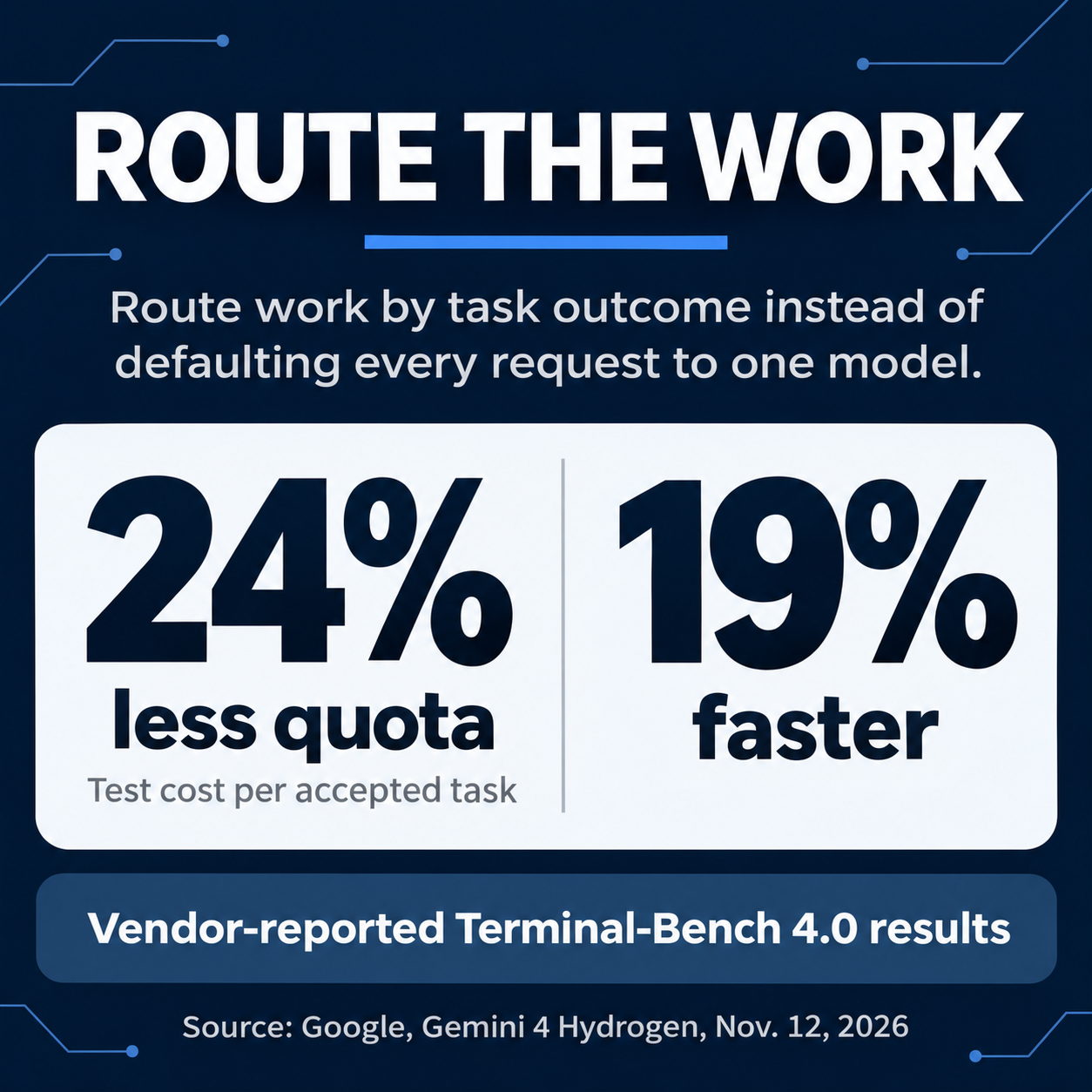
What happened. Google introduced Gemini 4 Hydrogen for fast coding and agent workflows, with four reasoning levels and a multi-model Orchestrator. In Google's Terminal-Bench 4.0 comparison, the routed setup reached near-Carbon task success while using 24% less quota and finishing 19% faster. AWS separately published a non-production model-routing sample and argued that the useful measure is cost per solved task: total run cost divided by runs whose tests pass, including failed attempts.
Why a smaller organization may care. Price per token does not tell you whether an invoice was classified correctly or a report passed review. A fast route may handle routine extraction, while a deeper route handles ambiguity. That can reduce delay and cost without lowering the acceptance bar. The tradeoff is a new routing policy that can itself make mistakes.
A useful first test this week. Choose 20 completed examples from one low-risk workflow. Define an accepted result before testing. Run every example through the current route, a faster route, and a two-lane route. Compare acceptance rate, retries, elapsed time, review time, and total cost. Keep the winner only if it improves the whole task.
What remains uncertain. Google's figures are vendor-reported benchmark results, not a forecast for your work. The AWS router is experimental sample code. A single approved model may remain easier to secure and operate when volume is low or examples are scarce.
2. Agent observability is moving into the working data layer
What happened. Google Cloud announced expanded agent observability and evaluation across BigQuery and Looker. The release covers first-party data agents and custom agents built with frameworks such as ADK or LangGraph. It is intended to show multi-step traces, data touched, token and query spend, and evaluation results while protecting sensitive reasoning and data.
Why a smaller organization may care. A normal application error can point to one request. An agent may search, call tools, retry, and hand work to another agent before returning an answer. Without a bounded trace, an operator cannot tell whether a bad result came from stale data, the wrong tool, a costly loop, or a weak evaluation. The tradeoff is telemetry volume and the risk of logging sensitive inputs.
A useful first test this week. For one internal assistant, record only the fields needed to explain five decisions: request ID, approved data sources, tools called, result status, review decision, elapsed time, and usage. Redact customer text and credentials. Reconstruct one success and one failure from the trace without opening a raw conversation dump.
What remains uncertain. A dashboard does not prove that the underlying evaluation is meaningful. If your team runs a single deterministic lookup, application logs may be enough. Add agent telemetry only when it helps someone diagnose, govern, or improve a real workflow.
3. Production learning needs a data permission before a data pipeline
What happened. AWS released SageMaker HyperPod Data Capture, which can record live model inputs and outputs to S3 at three tiers. Its walkthrough uses synthetic support traffic to find a new-product blind spot, label examples with a SQL policy, fine-tune a model, and measure the before-and-after result. AWS also details storage, request, compute, and query costs.
Why a smaller organization may care. Real work exposes formats, language, and exceptions that a launch test will miss. Captured examples can create a useful improvement loop. They can also contain personal information, confidential terms, customer prompts, or incorrect model output. The fact that a platform can capture traffic does not grant permission to retain or reuse it.
A useful first test this week. Before enabling capture, write a one-page record rule: allowed fields, prohibited fields, purpose, owner, retention period, deletion route, access list, redaction method, and whether examples may be used for evaluation or training. Start with a sampled, redacted stream in a test environment. Confirm deletion and access logs before collecting more.
What remains uncertain. The AWS example is synthetic and uses specialized infrastructure. A small team may get the same learning from reviewer reason codes and a curated error set. If consent, ownership, or deletion cannot be demonstrated, do not build the flywheel from production content.
4. Access roles and cache lifetime are becoming first-class AI controls
What happened. OpenAI's official API changelog records enhanced role-based access control on November 13 and extended prompt-cache retention up to 24 hours. Role-based access control means assigning permissions to a role such as evaluator or project administrator instead of granting every person the same access. A prompt cache reuses an already processed input prefix so repeated requests can be faster and cheaper.
Why a smaller organization may care. These are two sides of one operating question: who can use a capability, and how long can its processed context remain reusable? Better roles can reduce shared administrator access. Longer cache retention can lower repeated-work cost. The tradeoff is configuration drift and a data-lifetime choice that may not fit every sensitive workflow.
A useful first test this week. List the five AI actions with the greatest consequence. Map each to the smallest role that needs it, remove one unnecessary administrator grant in a test project, and verify denial for a lower role. Separately, test caching only with an approved, non-sensitive repeated prefix and compare latency, usage, and deletion expectations.
What remains uncertain. A provider role does not replace application-level authorization, and cache behaviour is provider-specific. If your process has few repeated inputs or strict data handling rules, a longer cache may offer little value. Keep business permission and tenant scope on your server.
5. Model retirement turns portability into a monthly operating task
What happened. GitHub announced that six Copilot models will be deprecated on December 14 across chat, inline edits, agent modes, and code completions. GitHub listed suggested alternatives and noted that business or enterprise administrators may need to enable replacement models when default enablement has been changed.
Why a smaller organization may care. A named model can disappear faster than a business workflow changes. A replacement may answer differently, cost more, or require a new policy setting. If the model name is scattered through prompts, automations, and instructions, a routine retirement becomes an urgent migration. The opportunity is to treat model choice as replaceable policy rather than product identity.
A useful first test this week. Search one workflow for hard-coded model names. Move the selected model and fallback into one owned configuration. Run ten accepted examples through the current and proposed replacement, then compare result quality, latency, usage, tool behaviour, and reviewer effort. Record the date and owner of the decision.
What remains uncertain. A ten-case set cannot predict every regression. Automatic replacement may be acceptable for low-risk drafting but not for consequential calculations or writes. A realistic reason to avoid multi-provider portability is that maintaining two integrations can cost more than a short, tested migration path.
6. Security controls are becoming policy-as-code, but each scan still needs a budget
What happened. GitHub added REST endpoints to manage AI Scan for repositories at organization and repository levels. Organization settings can block repository enablement, and a blocked combined update returns an error without applying either change. Enabling the setting does not start a scan; an authorized user still launches it, and each scan consumes security AI credits.
Why a smaller organization may care. A policy-as-code setting can make security coverage repeatable across repositories instead of relying on a checklist. It also separates permission to offer a scan from the act and cost of running one. That pattern is useful beyond code security: policy, execution, and evidence are different states.
A useful first test this week. Inventory active repositories and classify them by exposure and change rate. Enable the setting in one non-production organization through a reviewed script, verify inheritance and opt-out behaviour, then run one authorized scan. Save the request, policy result, findings count, credit usage, and remediation decision.
What remains uncertain. The feature is a public preview and does not support GitHub Enterprise Server. AI findings can be noisy or incomplete. If a repository is inactive or a conventional scanner already covers its languages well, another paid scan may not be the best next control.
7. Search is becoming an answer surface, so evidence has to survive extraction
What happened. Google says its Gemini 4 Hydrogen Search upgrade can interpret multi-part questions, fan out across more subtopics, show more links, and produce visual or structured responses. That change arrives while Canadian organizations are still uneven in adoption: Statistics Canada found 25.2% of businesses planned to use AI over the next year, while BDC reported 69% of Canadian SMEs were AI novices and 5% were AI leaders. Federal regional support has also expanded through a $700-million Regional Artificial Intelligence Initiative.
Why a smaller organization may care. Customers may meet a summarized answer before they see a website. Clear dates, authorship, scope, source links, and machine-readable facts help a search system and a person judge whether a page is useful. The opportunity is better discovery for firms with real expertise. The tradeoff is less control over how a search product summarizes that expertise.
A useful first test this week. Take one important public service page. Add a plain-language answer, named owner, updated date, source links, eligibility limits, and a direct next step. Check the page on mobile, in ordinary search, and through two different answer tools. Record inaccurate summaries rather than rewriting the page for one vendor's phrasing.
What remains uncertain. Provider claims do not guarantee traffic or accurate representation. The Canadian figures measure different adoption concepts and are context, not a direct before-and-after effect of this search release. If your buyers arrive through referrals and need a private conversation, improving one authoritative page may matter more than a broad answer-engine program.
Highest-value moves
- Define the accepted task before choosing the route. Measure outcome, retries, elapsed time, review effort, and total cost on real examples.
- Give every data path an owner and expiry. Decide what can be observed, cached, captured, retained, reused, and deleted before production traffic enters it.
- Keep models and scans behind policy. Centralize model choices, role permissions, fallbacks, scan eligibility, budgets, and evidence so a vendor change does not rewrite the business rule.
Today's strongest thesis
The fastest AI path is the one that sends each task only as far as its evidence, authority, and value justify.
Verified sources
- Google: Introducing Gemini 4 Hydrogen
- Amazon Web Services: Route coding agent requests to the right model on Amazon Bedrock
- Google Cloud: Enterprise AI agent observability with BigQuery and Looker
- Amazon Web Services: Build a model improvement flywheel with SageMaker HyperPod Data Capture
- OpenAI: OpenAI API changelog
- GitHub: Upcoming deprecation of selected GitHub Copilot models in December
- GitHub: Manage AI Scan for repositories using the REST API
- Google: Google Search gets a major upgrade with Gemini 4 Hydrogen
- Statistics Canada: Analysis on planned use of AI by businesses in Canada, third quarter of 2026
- Business Development Bank of Canada: Less AI hype, more results
- Government of Canada: Government of Canada expands support to adopt and commercialize AI
Continue your decision path
Move from understanding to action.
Daily Signal: Make accepted work grow faster than the queue
Seven practical signals for Canadian operators: accepted findings, deterministic tool checks, narrow permissions, drift benchmarks, agent ownership, voice consent, and funding readiness.
Read nextApply this signal to your architecture.
Identify the workflow, context, and controls to structure first.
Open Architecture Assessment