Operating question
As AI creates more findings, drafts, and actions, the useful operating measure is accepted work per unit of review, backed by narrow permissions and explicit ownership.
Decision Architecture
Daily Signal: Make accepted work grow faster than the queue
For
Leaders and workflow owners
You will leave with
4 operating decisions
Reading mode
11 min · 9 verified sources
Reading guide9 sections · Canadian briefing+
Highest-value moves
- 01Measure accepted distinct work and review time instead of celebrating the volume an AI system produces.
- 02Keep consequential tool calls behind deterministic checks that deny safely when evidence or authority is missing.
- 03Give every active agent a named owner, narrow permissions, a measurable outcome, and a retirement condition.
- 04Treat voice identity and funding applications as governed commitments, not feature or deadline reactions.
Seven practical signals for Canadian operators: accepted findings, deterministic tool checks, narrow permissions, drift benchmarks, agent ownership, voice consent, and funding readiness.
Today's strongest signal: more AI output is not the same as more finished work. Picture a familiar Monday morning: an owner opens a shared queue and finds 140 polished-looking recommendations, alerts, and draft responses. The team can produce them quickly. The real constraint is deciding which are distinct, which are safe, and which deserve a person's time.
The strongest releases from the past 72 hours point in one direction. AI can now find more issues, connect more business context, tune infrastructure, act through more tools, and even speak in a familiar voice. That opportunity is real. So is the new burden: acceptance rules, permissions, consent, ownership, and review capacity have to scale with output.
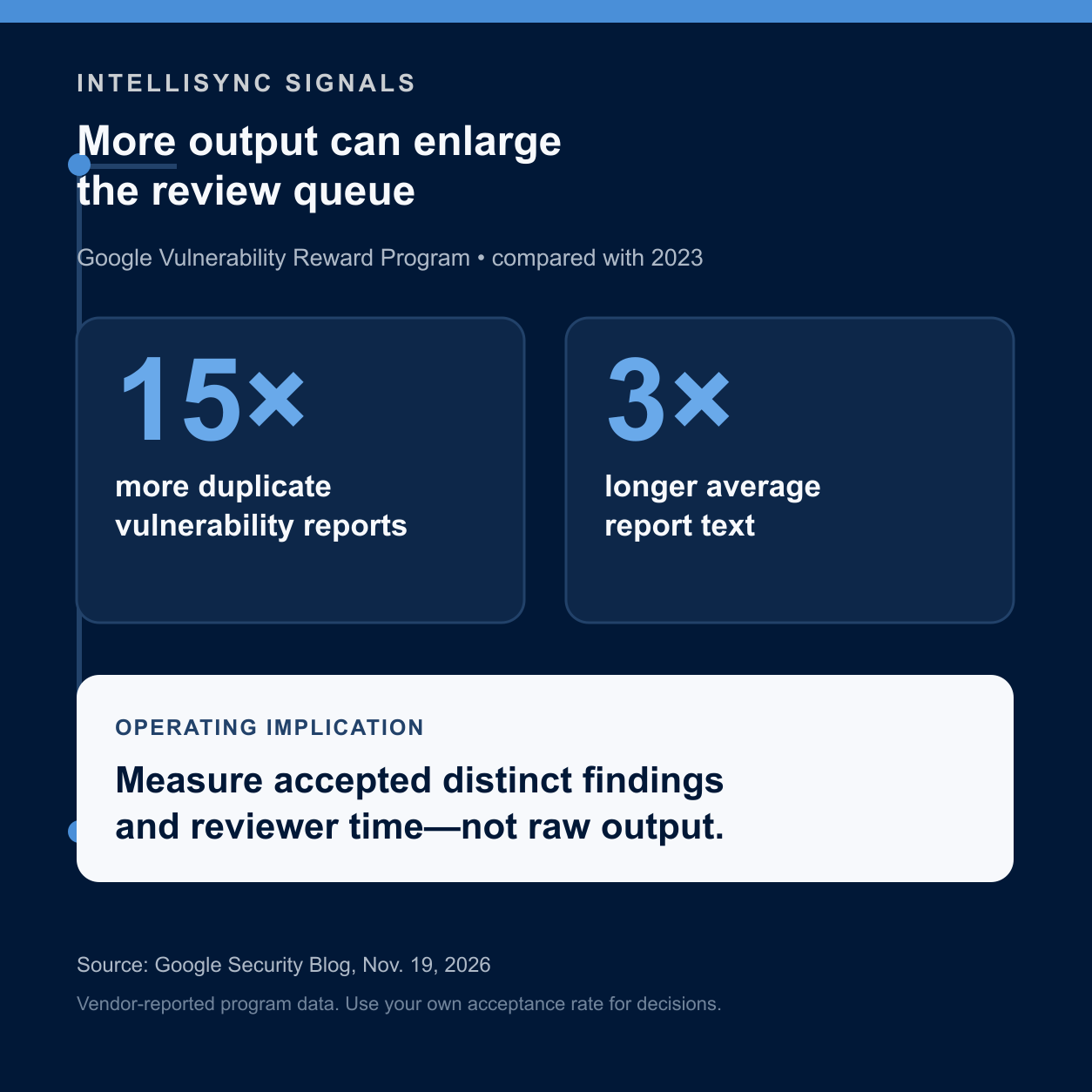
1. Measure accepted findings, not the size of the AI queue
Google says its vulnerability reward program now receives 15 times as many duplicate reports as in 2023, while average report text is three times longer. AI can help skilled researchers find and explain problems, but it can also produce repeated submissions and more text for the same underlying issue. Google is changing its disclosure process so researchers can share more detail publicly while the company manages the review burden.
Microsoft's fresh security guidance makes the complementary point: faster AI activity still depends on strong identity, least privilege, visibility, and verified patching. Least privilege means giving a person or system only the access needed for the current job. A faster finder does not repair an unclear owner, excessive access, or an ignored patch.
For a smaller organization, the lesson reaches beyond security. If AI drafts service exceptions, sales leads, quality alerts, or policy changes, count accepted distinct items and reviewer minutes, not drafts created. A useful first test is one weekly queue. Add a duplicate check, a required evidence link, an acceptance reason, and the name of the person who can close the item. Compare accepted throughput with the prior week.
The opportunity is wider coverage without asking people to inspect every record from scratch. The tradeoff is that deduplication and evidence checks take design work. A realistic reason not to add AI is low volume: if one experienced person already clears the queue in 20 minutes, another system may create more administration than value.
What remains uncertain is how Google's program figures translate to your work. Treat them as a warning about queue economics, then measure your own acceptance rate.
2. Put deterministic checks before consequential tool calls
AWS released an updated AgentCore harness with four lifecycle hooks around an agent invocation and its tool calls. A lifecycle hook is ordinary code that runs at a defined moment. A before-tool hook can deny a proposed refund or file change; an after-tool hook can record the result and stop further inference. AWS says hook failures deny by default unless an operator changes that setting, and delegated subagents pass through the same tool-call hooks.
That is useful because approval cannot live only in the prompt. A model can propose an action, but deterministic code can still check amount, customer status, user authority, required fields, and idempotency before the write. Idempotency means the same request cannot accidentally perform the action twice.
Illustrative scenario: a 35-person equipment distributor lets an agent prepare return credits. The agent can read the order and draft a reason. Code checks that the order exists, the requester is authorized, the amount is below the approved threshold, and the credit has not already been issued. Anything outside those rules goes to a manager. The agent saves time without becoming the financial authority.
A useful first test is one reversible action with a clear deny rule. Record proposed, allowed, denied, executed, and failed states separately. Confirm that a timeout or malformed check stops the action. The opportunity is faster routine handling with a visible policy. The tradeoff is maintaining the rules as products and authority change. A realistic reason not to automate the write is that the action is rare, high-value, or hard to reverse; a prepared draft may be enough.
What remains uncertain is whether a managed harness fits your existing stack. The durable principle does: every consequential tool call needs a server-side decision outside the model.
3. Connected context is valuable only when permissions stay narrow
AWS describes a seller experience that brings live marketplace, inventory, advertising, and operating data into one assistant. The practical appeal is obvious for a small multichannel seller: fewer exports, fewer spreadsheet joins, and a question answered from current stock and sales signals. The permission screen offers None, View, or Edit by data category, and AWS notes that the seller data does not include cost of goods. The system labels margin after marketplace fees rather than presenting it as gross margin.
This is a good pattern to borrow even if your team never uses the product. Start from a recognizable decision, name the systems required, and state what the connected data cannot answer. A useful first test is a weekly stock-risk review. Give the assistant read access only, require evidence beside each recommendation, and keep purchase orders as drafts until a named buyer approves them.
The opportunity is less time reconciling disconnected data and more time acting on exceptions. The tradeoff is a larger permission surface: a helpful connector can reach sales, customers, ads, inventory, accounting, and communications. A realistic reason not to connect everything is that the decision can be answered safely from two read-only exports. Integration cost and access risk may exceed the saved time.
Ask four plain questions before adding a connector: which decision needs it, which fields are necessary, who can see the result, and which action remains unavailable. If your team cannot answer those questions, the integration is not ready.
What remains uncertain is performance for Canadian sellers, because the Selling Partner plugin is described as beta for US stores. The operating test is still useful: use the smallest data path that can support the decision.
4. Quiet drift deserves a benchmark, not an automatic fix
AWS now monitors eligible SageMaker inference endpoints for week-over-week latency drift, underused GPUs, and missed configuration improvements. Inference is the production step where a trained model handles a request. The service looks at operational signals rather than request or response content, produces a notification, and offers to benchmark alternatives on separate compute. Production does not change until an operator applies a result.
Smaller organizations often experience the same pattern without owning a GPU. Prompts grow, retrieval adds more documents, a provider changes a model, and a once-fast workflow becomes slower or more expensive. Nothing fails loudly. Staff simply wait longer or stop using it.
A useful first test is a four-week baseline for one important workflow: median response time, accepted outputs, cost per accepted result, and failure rate. Review a change only when one measure drifts enough to matter. Test the alternative on a fixed case set before switching the production route.
The opportunity is to catch waste and service decline before a surprise bill or user complaint. The tradeoff is measurement overhead and the chance of chasing small fluctuations. A realistic reason not to build a monitoring platform is modest usage. A monthly export and a spreadsheet can reveal enough at first.
Keep the decision separate from the recommendation. A vendor can identify a possible improvement. Your team still owns the benchmark, customer impact, rollback plan, and change window.
What remains uncertain is which threshold matters for your users. A two-second increase may be harmless for an overnight report and damaging in a customer call. Set the service target from the business situation.
5. Every active agent needs an owner and a retirement path
Microsoft's Ignite release adds dynamic risk, agent inventory, tool governance, and business analytics to Agent 365. One planned action centre highlights inactive and ownerless agents. Another view links spending and outcomes across Microsoft and third-party agents. The products will change, but the management question is already here: who owns each agent, what can it reach, what does it cost, and is it still useful?
For a Canadian SME, a simple register can answer those questions before an enterprise control plane is justified. Include purpose, owner, users, data, tools, permission level, model or provider, monthly cost, last evaluation, incident contact, and retirement condition. A useful first test is to inventory every agent or automation that can write, send, publish, purchase, or change a customer record. Disable nothing during discovery; first confirm ownership and actual use.
The opportunity is to consolidate overlapping tools and find experiments that quietly became production dependencies. The tradeoff is keeping the register current. A realistic reason not to buy a governance platform is scale: a reviewed table with ten rows can be stronger than an expensive dashboard nobody owns.
Avoid counting chat access as an agent estate. Focus on systems that carry state, call tools, or continue work. Link each item to a real outcome such as accepted cases, hours saved, reduced errors, or faster response. Usage alone does not establish value.
What remains uncertain is how Microsoft's preview capabilities will behave across mixed vendors. Do not wait for perfect discovery. Ask owners to declare their tools, then reconcile that declaration with identity, device, and spending evidence where available.
6. A cloned voice starts with consent and ends with deletion
Amazon Polly launched gated voice cloning with consent confirmation, watermarking, account-scoped access, encryption, and deletion controls. The service supports seven languages, while AWS says Canadian French and other accents are less tested. A speaker's recordings can create a voice for customer service, training, media, or accessibility, but the technical ability to synthesize speech is only one part of the operating decision.
If your team sees a useful case, begin with the relationship, not the recording. Define who owns the original performance, which scripts and channels are allowed, how listeners are informed, who approves each locale, how withdrawal works, and who can delete the voice. A useful first test is a fixed internal training script, approved by the speaker before distribution. Do not start with live customer calls or open-ended text.
The opportunity is consistent narration and faster updates without repeatedly booking a studio. The tradeoff is identity risk, pronunciation errors, ongoing consent, and the possibility that listeners mistake generated speech for a fresh human statement. A realistic reason not to adopt it is that a neutral stock voice already meets the need without tying the system to a person's identity.
For bilingual use, treat English and French as separate reviewed assets. Do not assume one approved voice or script proves the other. Test names, numbers, addresses, disclosure wording, and the longest sentence in real listening conditions.
What remains uncertain is quality for Canadian accents and your exact vocabulary. The safe first test is small, disclosed, reversible, and easy for the speaker to hear and reject.
7. Funding deadlines reward a ready workflow, not an AI shopping list
Two live federal regional pages create near-term choices. FedDev Ontario says applications submitted by November 24 can cover projects beginning before March 31, 2027, with a final deadline of January 19, 2027. It also says a business can have only one application under assessment at a time. PacifiCan lists a November 23 noon Pacific deadline and different operating-history and employee-count rules for adoption and commercialization projects.
These are not reasons to invent a project this weekend. They are reasons to check whether a real project is already ready. A useful first test is a one-page investment case: workflow, baseline cost or delay, target outcome, eligible activities, data readiness, integration work, owner, adoption plan, evaluation method, cash-flow needs, and what continues after funding.
The opportunity is support for a defined adoption or commercialization effort. The tradeoff is application time, reporting, procurement, and spending before a decision at the applicant's risk. A realistic reason not to apply is that the deadline forces a vague problem into a large project. Run the smaller test, keep the evidence, and approach the next intake with a stronger case.
Confirm the official page and speak with the responsible agency before relying on eligibility or timing. This briefing is not funding advice. Programs differ by region, business history, project type, and start date.
What remains uncertain is selection and the final agreement. Build an investment case that still makes sense if public support is delayed or declined.
Highest-value moves
- Add one acceptance reason, evidence link, and reviewer-time measure to the busiest AI-generated queue.
- Put a deterministic allow-or-deny check before one reversible tool action and confirm that failures stop closed.
- List every agent that can write, send, buy, publish, or change a record, then name its owner and retirement condition.
Today's strongest thesis
AI earns its place when accepted work grows faster than the queue it creates.
Verified sources
- Microsoft On the Issues: Security fundamentals to enable the frontier
- Google Security Blog: Expanding Transparency: Google & Alphabet VRP Disclosure Policy Update
- AWS AgentCore: Amazon Bedrock AgentCore harness adds Strands harness defaults, built-in tools, and lifecycle hooks
- AWS Quick: Run your whole selling business in AWS Quick
- AWS SageMaker AI: Amazon SageMaker AI now detects latency drift, idle GPUs, and missed optimizations
- Microsoft News: Microsoft Ignite 2026 Book of News
- AWS Polly: Amazon Polly launches voice cloning: A unique voice for your brand
- FedDev Ontario: Regional Artificial Intelligence Initiative for businesses: When to apply
- PacifiCan: Regional Artificial Intelligence Initiative in B.C. - Who can apply
Continue your decision path
Move from understanding to action.
AI Go-Live Acceptance & Sign-off Pack
Turn this edition's decision points into a concrete working plan.
Daily Signal: Put a checkpoint where AI changes the work
Seven practical signals for Canadian operators: generated tools, machine-speed threats, workflow evidence, voice fit, benchmark discipline, and time-bound adoption funding.
Read nextApply this signal to your architecture.
Identify the workflow, context, and controls to structure first.
Open Architecture Assessment