Operating question
As agents gain simpler access to current information and business tools, a smaller organization gains durable speed by making evidence, permission, review, and exit receipts easier than the shortcut.
Decision Architecture
Make the Evidence Path as Easy as the Agent Path
For
Leaders and workflow owners
You will leave with
4 operating decisions
Reading mode
12 min · 10 verified sources
Reading guide9 sections · Canadian briefing+
Highest-value moves
- 01Put source, permission, budget, and citation rules in deterministic code before letting an agent search current information.
- 02Treat a fresh tool description and an approved tool version as separate states that require separate evidence.
- 03Carry customer evidence and accountable human decisions through a multi-agent workflow instead of optimizing only for output speed.
- 04Write the exit receipt and measured Canadian workflow before scaling a provider commitment or funding application.
New search, policy, registry, workflow, infrastructure, and funding signals point to one practical SME advantage: make evidence and control the convenient path.
Today's strongest signal: the path from an AI answer to a business action is getting shorter, so a small company gains more from an easy evidence-and-control path than from another clever demo.
Picture a 28-person Ontario parts distributor. A service lead asks an agent which supplier notices changed overnight. The agent can now search current pages through one managed call, summarize the changes, and draft updated purchasing guidance. That speed is useful. It also compresses three different decisions: which sources count, which policy meaning changed, and who can approve the new guidance.
The preceding 72 hours made that pattern visible. AWS released a direct web-search interface with identity controls and citations, showed a deterministic way to compare policy meaning, published an event-driven tool-registry update pattern, and laid out a six-agent product workflow with human approval at every gate. Anthropic began the roadshow for a large public offering, giving buyers unusually detailed evidence about how quickly one provider is becoming embedded in costly business workflows.
The opportunity is not to slow the tools down. It is to make the checked path the convenient path. The tradeoff is more setup before the first impressive result. A realistic reason not to adopt a capability is simple: if your team cannot name the approved sources, permission, stopping rule, reviewer, and receipt, the faster route may create a larger reconciliation job later.
Illustrative scenario: the distributor limits its first test to three public supplier sites and one weekly purchasing note. The agent may search and draft, but it cannot change the approved domain list, edit the purchasing policy, or send the note. A service lead checks every changed claim against its linked page, and the operations manager approves the final note. After four weeks, they compare research time, missed changes, false alarms, corrections, and review time with the old process. This scenario is illustrative; it is not a reported deployment.
1. Current web evidence is becoming a normal tool call
What happened. AWS announced a direct Web Search API for Amazon Bedrock AgentCore. Code can call it through standard AWS credentials without first creating a gateway. Results can include a title, URL, extract, and publication time. Requests can limit domains, dates, and result counts. AWS says the service uses its own index, supports identity and network controls, and requires applications to retain and display source citations. CloudTrail can record calls as data events, although that logging is not on by default.
Why a smaller organization may care. A team can add fresh evidence to a dashboard, monitor, or agent without building a separate search gateway. The useful change is not merely that search is easier. It is that the call can sit behind the same identity rules as other cloud services. The tradeoff is that each request can carry its own filters, so an agent may widen a domain list unless deterministic code keeps that choice outside the prompt.
A useful first test this week. Pick one low-risk question that regularly goes stale, such as supplier service notices or a regulator's public updates. Put the approved domains, date floor, maximum results, query budget, timeout, and retry limit in code. Require every reported claim to preserve its source URL and checked time. Compare ten answers with manual research, including one case where no adequate source exists.
What remains uncertain. Search ranking is not the same as truth, and a reachable page can still be outdated or ambiguous. Pricing and regional availability may not fit a small workload. If your question changes only monthly and one authoritative page answers it, a scheduled deterministic fetch can remain cheaper, clearer, and easier to audit.
2. Compare policy meaning, not just policy text
What happened. AWS published an open approach to semantic diffing of formal policies. A semantic diff compares meaning after equivalent expressions are normalized, rather than treating every textual change as a behavioural change. The example keeps the model out of the comparison itself: a model may draft candidate rules, but deterministic code identifies where candidates agree and disagree. The workflow can route disagreements to schema checks, replay, example inputs, solvers, or human review.
Why a smaller organization may care. Teams increasingly turn plain-language instructions into permissions, routing rules, eligibility tests, or agent guardrails. Two drafts can look different while behaving the same, or look similar while changing who can approve a refund. A semantic comparison can reduce review noise and direct scarce attention to real behaviour changes. The tradeoff is that the business rule must first be represented precisely enough to compare.
A useful first test this week. Choose one bounded rule with real examples: “A refund above $500 needs a manager who did not create the order.” Write ten allowed and denied cases. Generate or hand-write two candidate implementations, then replay the cases and list every disagreement. Ask the rule owner to resolve only those disagreements. Keep the examples as regression tests.
What remains uncertain. Formal methods can expose disagreement without proving that the original requirement is wise or complete. If a rule changes rarely and is easily expressed in a short table, direct tests may provide more value than a new policy language. Do not let an elegant comparison become a substitute for the accountable owner.
3. A tool catalogue needs freshness and approval as separate states
What happened. AWS described an event-driven pattern for updating an agent and MCP tool registry. CloudTrail observes a runtime update, EventBridge routes the event, a Lambda function retrieves the current tool list through managed identity, and the registry changes only when the schema differs. The proposed flow does not make the changed tool instantly discoverable. It returns the registry record to draft so the updated capability passes approval again.
Why a smaller organization may care. A catalogue becomes dangerous when its description lags the tool. An agent may call an old input shape, miss a new consequence, or assume a removed limit still exists. Automatic sync closes the freshness gap. Returning the record to draft closes a different gap: a fresh description does not prove the tool remains authorized for every workflow.
A useful first test this week. Inventory the five tools with the widest business reach. For each, record the owner, schema version, permissions, data touched, last verified time, approval state, and workflows that depend on it. Trigger a harmless schema change in a test environment. Confirm that monitoring detects it, consumers cannot silently use the changed version, and a reviewer can see the exact difference before reapproval.
What remains uncertain. The published architecture assumes AWS services and a pre-registered tool. A smaller team may get the same result with a signed manifest and CI check. If you have only two stable internal tools, a registry service may be unnecessary. The invariant matters more than the platform: change detection and authorization are different events.
4. Multi-agent speed is useful only when decisions keep their evidence
What happened. AWS published a six-agent product-development workflow that moves from discovery through prioritization, working-backwards analysis, specification, and design. The agents gather scattered context and produce traceable artifacts, while people approve decisions at each gate. The workflow carries customer evidence into a shared specification before a coding agent begins implementation.
Why a smaller organization may care. Coding can become faster than deciding what deserves to be built. A small team can lose time by generating the wrong feature more efficiently. The useful pattern is a shared evidence packet and explicit decision gates, not the number of agents. The tradeoff is that connecting every conversation, ticket, and document can create privacy, access, and context-cost problems.
A useful first test this week. Use one product or process decision that already has a named owner. Gather only the customer evidence needed to choose among two options. Ask one agent to structure the evidence, another to challenge missing assumptions, and a person to approve the decision. The final specification can include the source, decision, rejected alternative, acceptance checks, and owner. Do not connect private systems until the manual evidence packet works.
What remains uncertain. The AWS example is a reference architecture, not independent proof of better products. Six agents may be more ceremony than a lean team needs. If three customer calls and a one-page brief settle the decision, keep the simpler path. Add orchestration only when it preserves context or catches a recurring failure that you can measure.
5. Provider scale makes exit evidence a purchasing requirement
What happened. Anthropic launched the roadshow for its proposed initial public offering, with 825 million Class A shares in the proposed offering and an expected price range of US$70 to US$78. Its preliminary prospectus reports more than 11,900 customers generating at least US$100,000 in trailing-12-month revenue as of September 30, 2026, up from more than 950 a year earlier. It also reports more than 1,900 customers above US$1 million and says more than half of its higher-revenue customers used both its platform and at least one first-party application.
Why a smaller organization may care. This is not a stock tip. It is buyer evidence that AI providers are becoming deeply embedded across application and platform layers. One vendor can be your model supplier, coding environment, knowledge tool, and workflow interface. That can reduce integration work. It can also make price, policy, outage, and migration decisions harder.
A useful first test this week. For one important AI workflow, write an exit receipt before expanding it: exported prompts or instructions, source records, tool schemas, evaluation cases, data-retention terms, current usage, replacement owner, and the maximum acceptable interruption. Run one sample case through a second route. Measure the difference in output, cost, and operating work.
What remains uncertain. Prospectus figures are company disclosures prepared for an offering, not a forecast for your outcome. Scale may improve continuity and product investment, while migration work may still exceed the practical risk for a small use case. If the workflow is reversible and low consequence, a lightweight export check can be enough.
6. Specialized infrastructure does not remove the need for workload evidence
What happened. As useful context for the week's tool releases, Google described TPU 8tx for confidential inference and TPU 8i Max for high-context workloads. Google says 8tx adds hardware-level protections for sensitive workloads, while 8i Max combines two chips to double compute and memory resources relative to TPU 8i. It also presents different systems for training, low-latency reasoning, confidential work, and large context windows.
Why a smaller organization may care. AI infrastructure is being specialized around workload shape. That can improve security, latency, or price performance. It also makes a generic “move to AI infrastructure” proposal less useful. A customer-support classifier, a contract assistant, and a long-running coding agent do not create the same data, memory, or availability needs.
A useful first test this week. Measure one real workload before discussing hardware: peak input size, sensitive fields, latency target, concurrency, failure cost, accepted-result rate, and monthly ceiling. Ask vendors to price and demonstrate that exact case. Keep the data-classification and authorization rules above the infrastructure layer so a future hardware change does not rewrite the business boundary.
What remains uncertain. Google published the performance and design claims, and the source predates the 72-hour signal window, so it is context rather than a new signal. Independent results for your workload may differ. If a managed model API already meets the need and no regulated data leaves an approved boundary, specialized compute can add complexity without changing the business outcome.
7. Canadian adoption is rising; fund a measured workflow, not a vague ambition
What happened. Statistics Canada reports that 25.2 per cent of Canadian businesses planned to use AI over the next 12 months in the third quarter of 2026, up from 14.5 per cent in 2025 and 10.6 per cent in 2024. Among businesses planning use, data analytics, large language models, and virtual agents were the most common application types. Separately, the federal government says its expanded Regional Artificial Intelligence Initiative supports adoption and commercialization; southern Ontario projects with eligible costs before March 31, 2027 have a November 24 submission date. In British Columbia, the current business intake closes November 23 at noon Pacific and lists repayable support for adoption and commercialization projects that meet its eligibility rules.
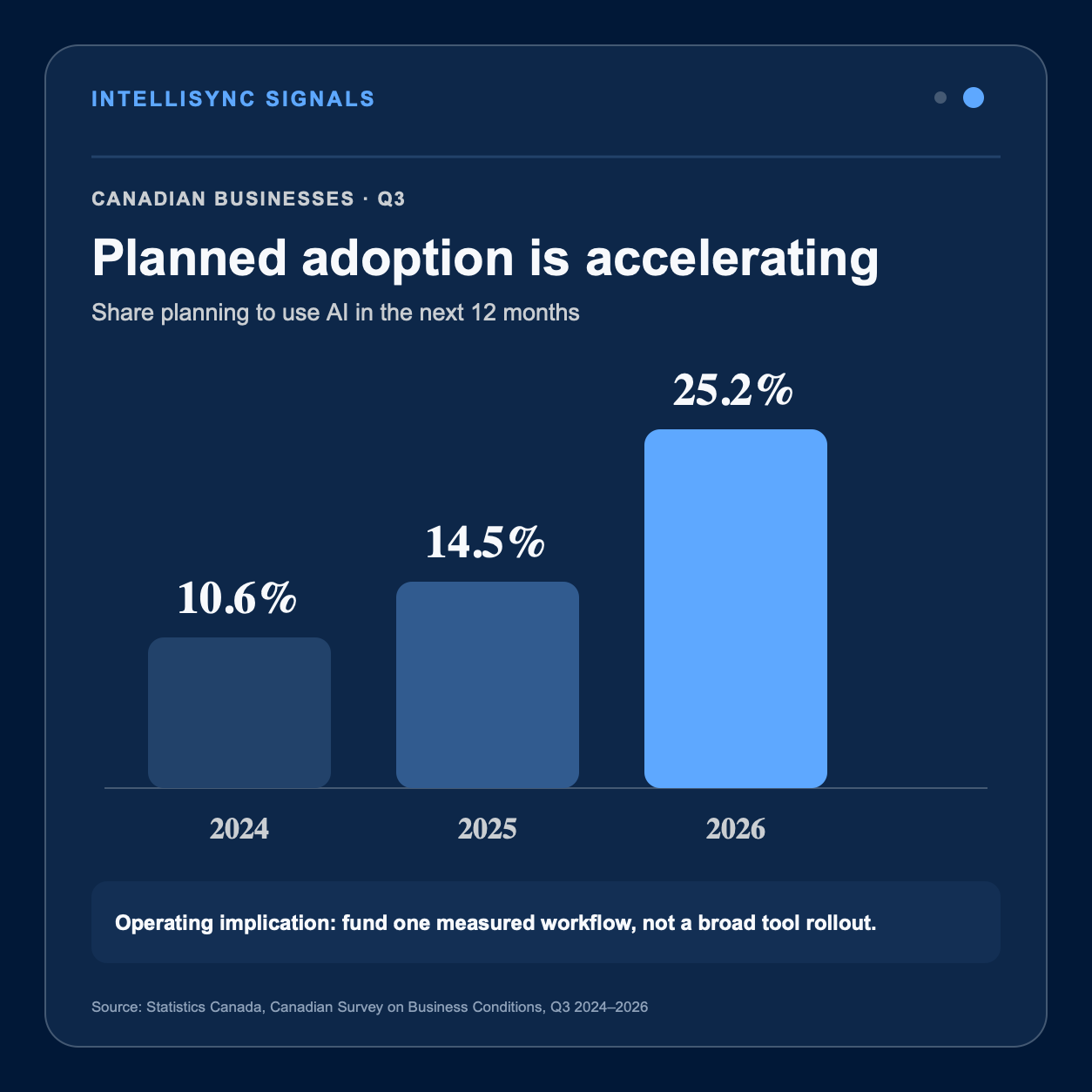
Why a smaller organization may care. Adoption is moving from isolated experiments toward ordinary planning. Funding may help with integration, training, security, or commercialization. The tradeoff is application and reporting work, and regional rules differ. A deadline can encourage a rushed tool purchase when the funder and the business both need a defined project with measurable results.
A useful first test this week. Write a one-page project before speaking with a vendor or funder: workflow today, baseline time and error rate, affected people, permitted data, proposed change, owner, 90-day target, evidence plan, budget, stopping rule, and what continues without funding. Confirm eligibility directly with the relevant regional agency before incurring costs.
What remains uncertain. Surveyed plans are not completed adoption or realized productivity. Funding is not approval, and costs can remain the applicant's risk. If the team lacks a stable workflow, usable baseline, or owner, a small self-funded test can be more valuable than a larger application.
Highest-value moves
- Put source and permission choices in code. For one current-information workflow, lock the approved domains, query budget, tool permissions, and citation receipt outside the model prompt.
- Separate freshness from approval. When a tool, policy, or source changes, detect the change automatically but require a new acceptance check before the changed version becomes active.
- Write the exit and evidence receipt before scale. Preserve the evaluation cases, source records, versions, owners, usage, and replacement route for one important AI workflow.
Today's strongest thesis
The fastest trustworthy agent path is the one where evidence, permission, and review are easier to follow than the shortcut.
Verified sources
- Amazon Web Services: Direct Web Search API for Amazon Bedrock AgentCore
- Amazon Web Services: Semantic diffing of formal policies with anti-unification
- Amazon Web Services: Automating AWS Agent Registry updates with push-based architecture
- Amazon Web Services: Accelerating product development with AI-driven lifecycle management
- Anthropic: Anthropic launches roadshow for proposed initial public offering
- Anthropic: Anthropic preliminary prospectus
- Statistics Canada: Analysis on planned use of artificial intelligence by businesses in Canada, third quarter of 2026
- Government of Canada: Government of Canada expands support to adopt and commercialize artificial intelligence
- PacifiCan: Regional Artificial Intelligence Initiative in B.C. - Who can apply
- Google: Our newest TPUs: 8tx and 8i Max, built for the agentic era
Continue your decision path
Move from understanding to action.
Daily Signal: Make accepted work grow faster than the queue
Seven practical signals for Canadian operators: accepted findings, deterministic tool checks, narrow permissions, drift benchmarks, agent ownership, voice consent, and funding readiness.
Read nextApply this signal to your architecture.
Identify the workflow, context, and controls to structure first.
Open Architecture Assessment