Operating question
As agents gain reach, dependable execution starts with governed business meaning, bounded permissions, repeatable failure tests and business-outcome evidence.
Organizational Intelligence Design
Context Is the Control Surface
For
Leaders and workflow owners
You will leave with
4 operating decisions
Reading mode
11 min · 9 verified sources
Reading guide9 sections · Canadian briefing+
Highest-value moves
- 01Assign owners to important business definitions before agents combine data across systems.
- 02Watch agent behaviour inside valid permissions and retain a usable interruption path.
- 03Test hostile, ambiguous and duplicate cases before granting consequential write access.
- 04Measure the business service outcome beside model, tool and infrastructure health.
Agents are gaining tools and reach. Canadian SMEs can create dependable value by owning definitions, testing drift, measuring outcomes and keeping recovery real.
Today's strongest signal: the most useful agent is not the one that speaks most fluently. It is the one that receives the right business meaning, sees only the right records, and stops before an uncertain action becomes a customer problem.
Consider a 45-person Ontario wholesaler. Sales calls a customer "active" when an order was placed in the past year. Finance uses the same word for an account with no overdue balance. Service means a customer with a current support agreement. An AI agent connected to all three systems can produce a confident answer while each team quietly means something different. The model is not missing vocabulary. The business is missing an owned definition.
The strongest developments from the preceding 72 hours make that gap harder to ignore. Snowflake introduced tools for governed business definitions and centralized agent controls. CrowdStrike announced controls for agents that drift inside approved permissions and separate plans for automated adversarial testing. Check Point Research described hidden instructions that can persist in a local agent environment. Google highlighted smaller on-device retrieval models. Canadian data-centre principles connect growing compute demand to grid costs and community impacts. In southern Ontario, a funding deadline gives qualified firms a near-term reason to turn an idea into an evidence-backed project.
The opportunity is practical. A smaller team can use an agent to interpret messy requests, retrieve approved context, prepare a decision, or run a reversible task. The tradeoff is that someone must define the business term, approve the data, set the action limit, watch the outcome and own recovery. A realistic reason not to adopt is simple: if the workflow changes every week or nobody owns its exceptions, an agent may multiply ambiguity faster than it saves time.
Illustrative scenario: the wholesaler tests an order-status agent for internal staff. It can read current orders and shipping events but cannot change a delivery address. The term "priority customer" comes from one approved rule with a named owner and review date. If the customer record and invoice record disagree, the agent returns the conflict and routes it to operations. Staff compare 30 old cases against the original records. This scenario is illustrative, not a reported deployment.
1. Give important business words an owner
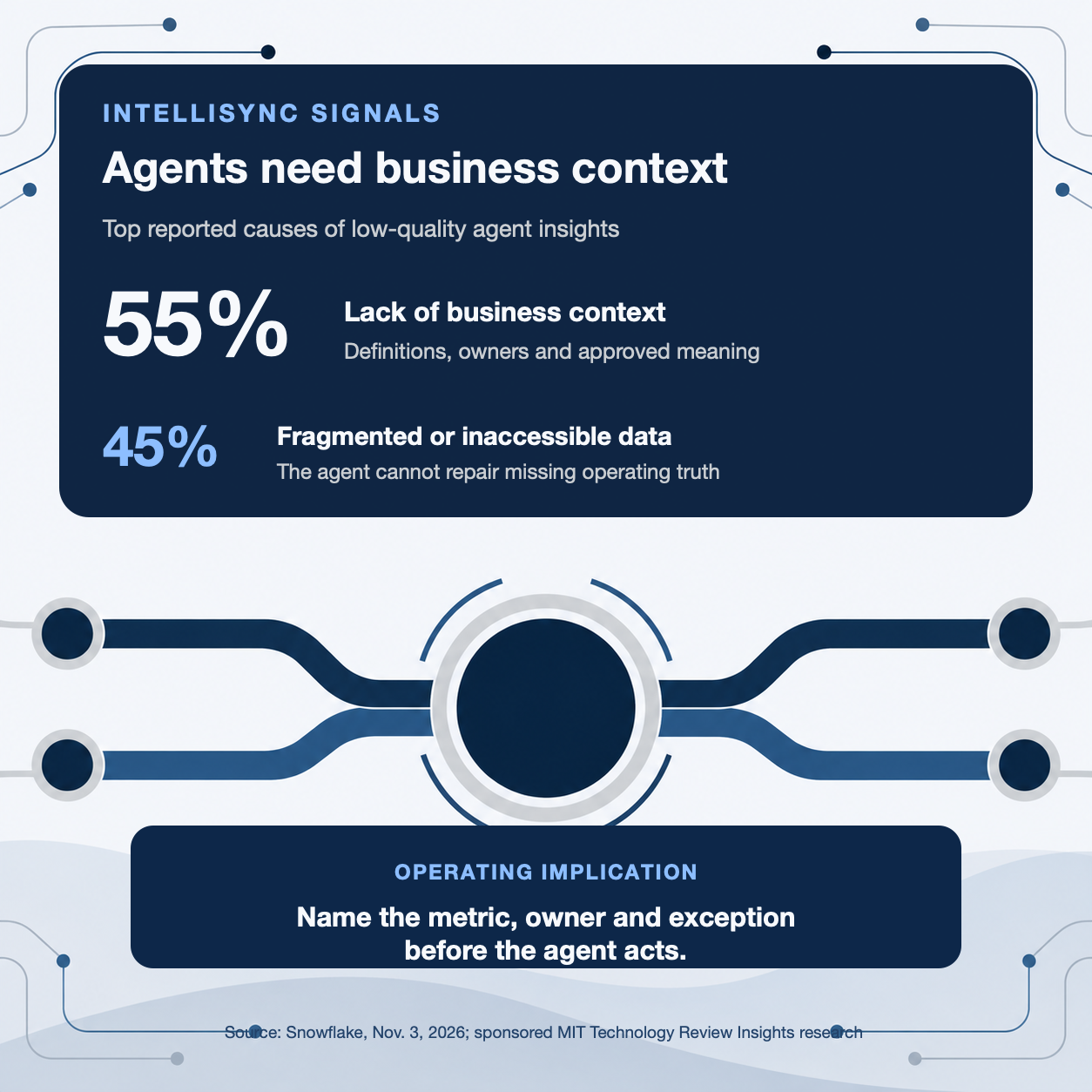
What happened. On November 3, Snowflake announced a Business Ontology and Cortex AI Gateway. An ontology is a governed map of what business terms mean and how they relate. Snowflake says the ontology can supply approved definitions to agents, while the gateway controls model access, tools, actions, usage and spending. The announcement cites sponsored MIT Technology Review Insights research in which 55% of executives named missing business context as the main cause of low-quality agent insights and 45% pointed to fragmented or inaccessible data. Those are survey findings reported by a vendor, not a universal benchmark.
Why a smaller organization should care. You do not need an enterprise data platform to have the same problem. Gross margin, qualified lead, completed job, active client and urgent ticket can each have several local meanings. When an agent searches across systems, disagreement becomes a confident blended answer. A short approved definition, calculation and owner may improve results more than another prompt or model upgrade.
A useful first test this week. Pick one measure used in a weekly meeting. Write its definition, source system, calculation, owner, refresh timing and allowed exceptions on one page. Give the agent ten questions that use the term in different ways. Check whether every answer points to the approved meaning and flags missing data.
What remains uncertain. Snowflake's products may be too large or costly for a small team, and the survey was sponsored. The operating pattern still travels well: keep meaning outside the model and assign an accountable owner. If the business has only one simple source, a maintained data dictionary may be enough.
2. Watch for drift inside valid permissions
What happened. CrowdStrike's November 4 agent-insider announcement describes an agent that uses a real employee identity and approved tools yet changes behaviour after a compromised tool or hidden instruction. The company introduced or previewed behaviour baselines, risk scoring, human action requests, interruption and credit controls. Several features are scheduled for the fourth quarter and remain subject to change. Canada's agentic-AI guide reaches a similar operating conclusion: bound autonomy, preserve human checkpoints and keep recoverable evidence outside the agent.
Why a smaller organization should care. Permission answers "may this identity call the tool?" It does not answer "does this action still match the original request?" A bookkeeping agent may be allowed to read invoices but suddenly read hundreds at midnight. A service agent may use an approved messaging tool yet contact the wrong group. Linking the agent, person, device, task and outcome makes unusual behaviour easier to see.
A useful first test this week. Record a normal baseline for one agent: tools called, records read, time of day, volume, cost and expected outcome. Add three alerts for a new destination, an unusual volume and an action after the task was cancelled. Confirm that an operator can pause access without disabling the entire business system.
What remains uncertain. Behaviour alerts can create noise, and a new workflow may look abnormal even when it is legitimate. A tiny, read-only assistant may not justify a specialized security platform. Start with logs, cost caps and a kill switch your team can actually use.
3. Test the agent like a determined user would
What happened. On November 3, CrowdStrike announced an agreement to acquire Dreadnode and described plans to add continuous, automated adversarial testing to its platform. Adversarial testing deliberately tries to make a system fail: crossing a permission boundary, leaking data, following a hostile instruction or taking an unsafe action. The acquisition is not proof that every promised capability is available today, but it shows that agent testing is becoming an operating product rather than an occasional workshop.
Why a smaller organization should care. A happy-path demo proves very little. Real users paste odd documents, retry after timeouts, use ambiguous language and connect tools in unexpected orders. Attackers do this deliberately. A short library of repeatable failure tests can catch the most damaging paths before customers or staff discover them.
A useful first test this week. Create ten cases for one workflow: three normal, two ambiguous, two hostile, one duplicate retry, one expired authorization and one unavailable tool. Define the expected safe result before running them. Save the trace and rerun the set after every prompt, model, tool or permission change.
What remains uncertain. Automated testing cannot anticipate every social or technical failure, and vendor claims need independent validation in your environment. If the workflow only drafts internal text, a modest review set may be proportionate. If it can pay, publish, delete or message externally, the test bar needs to rise.
4. Treat local instructions as software supply chain
What happened. Check Point Research reported "prompt adware" on November 3, describing a jailbreak bundle called Haiou that can modify local Codex instructions and persist into later sessions. The report is about a specific research finding, not evidence that every local agent is compromised. Its practical signal is broader: configuration files, skills, plugins and copied setup commands can change how an agent behaves long after the original conversation ends.
Why a smaller organization should care. Teams often treat instructions as harmless text. In an agent environment, that text can decide which tools are called, what evidence is trusted and whether a confirmation is requested. A copied skill or installer deserves the same care as a script: known source, narrow permissions, change review and a way to remove it.
A useful first test this week. Inventory agent instruction files, plugins and MCP connections on one workstation. Record owner, source, install date, permissions and hash. Remove anything unused. Change one test file and confirm your monitoring detects it before the next agent run.
What remains uncertain. The threat may be low for a disconnected sandbox with no secrets or write tools. Hash checks also do not prove that approved instructions are safe. If your team lacks managed devices or software inventory, start there rather than buying an AI-specific control.
5. Make pause and recovery part of the workflow
What happened. CrowdStrike's November 4 agent-control announcement includes human action requests, mid-task interruption and spending controls. The specific product features are vendor claims, and some are not yet generally available. The consequential pattern is simpler: a team needs a real way to pause an agent, preserve its trace and recover the business service without relying on the same agent to diagnose itself.
Why a smaller organization should care. A dashboard can say the model responded, the API returned 200 and the workflow completed. None of those prove that the right order shipped, the correct invoice was issued or the customer received a useful answer. The best operating metric often sits one step later than the AI task.
A useful first test this week. Choose one agent-assisted service and write three lines: what must continue, how failure appears to the customer and what restored means. Track one outcome rate beside technical uptime. Give one person authority to pause the agent, then rehearse the pause and manual fallback with a saved trace.
What remains uncertain. Outcome measures arrive later and may be influenced by factors outside the agent. A manual fallback can fail too. Compare against the previous baseline, and do not claim the model caused an improvement until the evidence separates it from seasonality, staffing or demand.
6. Local retrieval creates a smaller option, not an automatic answer
What happened. Google's November 2 AI roundup highlighted EmbeddingGemma 2, a small model for mapping text, images, audio and video into a searchable representation. The technical announcement says it can run on-device, work offline and reduce local vector storage by up to six times. An embedding is a numerical representation used to find similar items; it is not the original record or a factual answer.
Why a smaller organization should care. Local retrieval may help a field team search manuals, photos or recordings without sending every file to a cloud service. It can reduce latency and support privacy-sensitive use. The tradeoff is device management, model updates, storage, evaluation and a narrower capability than a hosted end-to-end assistant.
A useful first test this week. Take 100 approved documents or media files and 20 real search questions. Compare local retrieval with the current manual search on accuracy, time, device memory and support effort. Keep the original source visible so a user can confirm the match before acting.
What remains uncertain. Google's figures are provider-reported and performance will vary by language, file type and device. Local processing does not remove privacy duties or access control. If a hosted search already meets the need with acceptable terms and cost, local deployment may add complexity without enough gain.
7. Put infrastructure and funding assumptions in the business case
What happened. Canada's Responsible Data Centre Development Principles say project proponents should pay connection, generation, transmission, substation and grid-upgrade costs attributable to their facilities. The principles also call for grid reliability, efficient water use and transparent environmental reporting. Closer to home, FedDev Ontario lists November 24 as the deadline for Regional Artificial Intelligence Initiative projects with eligible costs beginning before March 31, 2027; the final application deadline is January 19, 2027.
Why a smaller organization should care. AI cost is not only a model price. It includes data movement, integration, review, compute, vendor concentration and the infrastructure behind the service. Funding may improve the case for a real adoption project, but it does not rescue a vague use case. Any costs incurred before approval remain at the applicant's risk.
A useful first test this week. Build a one-page case for one workflow: current labour and error cost, expected volume, model and infrastructure cost, human review, implementation, fallback, evidence plan and a stop rule. If funding is relevant, map each eligible cost to a dated project activity before November 24.
What remains uncertain. National principles are not a price forecast for one business. Funding eligibility and decisions depend on the programme and application. A small team with low volume may get better returns from process cleanup or conventional automation than from an agent project.
Highest-value moves
- Give one important business term a definition, source, owner and exception rule.
- Add a repeatable hostile-input test and a working pause control to one agent workflow.
- Measure the customer or business outcome beside model and system health.
Today's strongest thesis
An agent can speak without context; it cannot be trusted to act without it.
Verified sources
- Snowflake: Snowflake Helps Enterprises Deploy AI Agents with Trusted Business Context and Built-In Controls
- Government of Canada: Guide on the Use of Agentic Artificial Intelligence
- CrowdStrike: CrowdStrike Extends the Agentic SOC to Detect and Stop Agent Insider Threats
- CrowdStrike: CrowdStrike to Acquire Dreadnode
- Check Point Research: Prompt Adware: A New AI Security Risk
- Google: The latest AI news we announced in October 2026
- Google: EmbeddingGemma 2: an open, lightweight multimodal embedding model
- Innovation, Science and Economic Development Canada: Canada's Responsible Data Centre Development Principles
- FedDev Ontario: Regional Artificial Intelligence Initiative for businesses: When to apply
Continue your decision path
Move from understanding to action.
Daily Signal: Make accepted work grow faster than the queue
Seven practical signals for Canadian operators: accepted findings, deterministic tool checks, narrow permissions, drift benchmarks, agent ownership, voice consent, and funding readiness.
Read nextApply this signal to your architecture.
Identify the workflow, context, and controls to structure first.
Open Architecture Assessment