Operating question
As agents gain access to established tools and workflows, Canadian SMEs can create value by keeping identity, authorization, deterministic execution and receipts outside the model.
Agent Systems
The Agent Is Not the Workflow
For
Leaders and workflow owners
You will leave with
4 operating decisions
Reading mode
12 min · 12 verified sources
Reading guide9 sections · Canadian briefing+
Highest-value moves
- 01Connect agents to existing governed workflows instead of recreating business rules in model prompts.
- 02Resolve identity and permissions on the server, then expose only the tools each principal may use.
- 03Test hostile inputs, duplicate retries, approvals and recovery before granting write access.
- 04Treat monitoring, model routing and media verification as evidence layers rather than authorization.
Agents can now reach existing business workflows more easily. Canadian SMEs still need server-side identity, approval, order, recovery and evidence.
Today's strongest signal: agents are getting easier to connect to work your business already trusts. The useful question is no longer whether an AI assistant can call a refund, scheduling, reporting or customer-service process. It is whether identity, approvals, sequence, limits and evidence stay intact when the model decides to act.
Picture a 60-person Ontario equipment distributor. A service coordinator receives warranty requests by email, checks the serial number in an inventory system, confirms eligibility, asks a manager about exceptions and creates a credit in accounting. The company already has a reliable workflow for those steps. A vendor now says an agent can call it without rebuilding the process. That creates a real opportunity: less copying, faster response and better after-hours triage. It also creates a clean new failure point. If the agent can choose the customer, amount or approval path without server-side checks, the old workflow is no longer the control it appeared to be.
The strongest developments from the preceding 72 hours point in one direction. AWS highlighted agents calling established workflows; OpenAI described new behaviour monitors; Google paired faster capability releases with broader content-verification tools; and Microsoft opened a programme that joins technical help to commercialization. Canadian governments are asking for traceability, reassessment and human oversight while Ontario connects adoption to infrastructure, sovereignty and skills. The common lesson is practical: model access is becoming easier, but dependable execution still comes from ordinary business controls.
The opportunity is not to replace every process with an agent. It is to let a model handle uncertain language or choose among approved actions while deterministic software keeps the rules that cannot drift. The tradeoff is setup work. Someone has to define identities, permissions, approvals, receipts, stopping conditions and a fallback. A realistic reason not to adopt is a weak underlying process. If the team cannot agree on the current rule or exception owner, giving the process a conversational front door may make confusion faster rather than make service better.
Illustrative scenario: the distributor lets an agent read a warranty request and propose one of three approved workflow calls. The server resolves the customer and tenant from the signed session, not from model text. Claims under $250 can proceed only after the existing eligibility checks. Larger or ambiguous claims stop in a manager queue. Every call receives an idempotency key, which prevents the same credit from being created twice, plus a trace that records the request, approval and outcome. This scenario is illustrative, not a reported customer case.
1. Connect the agent to the workflow, not around it
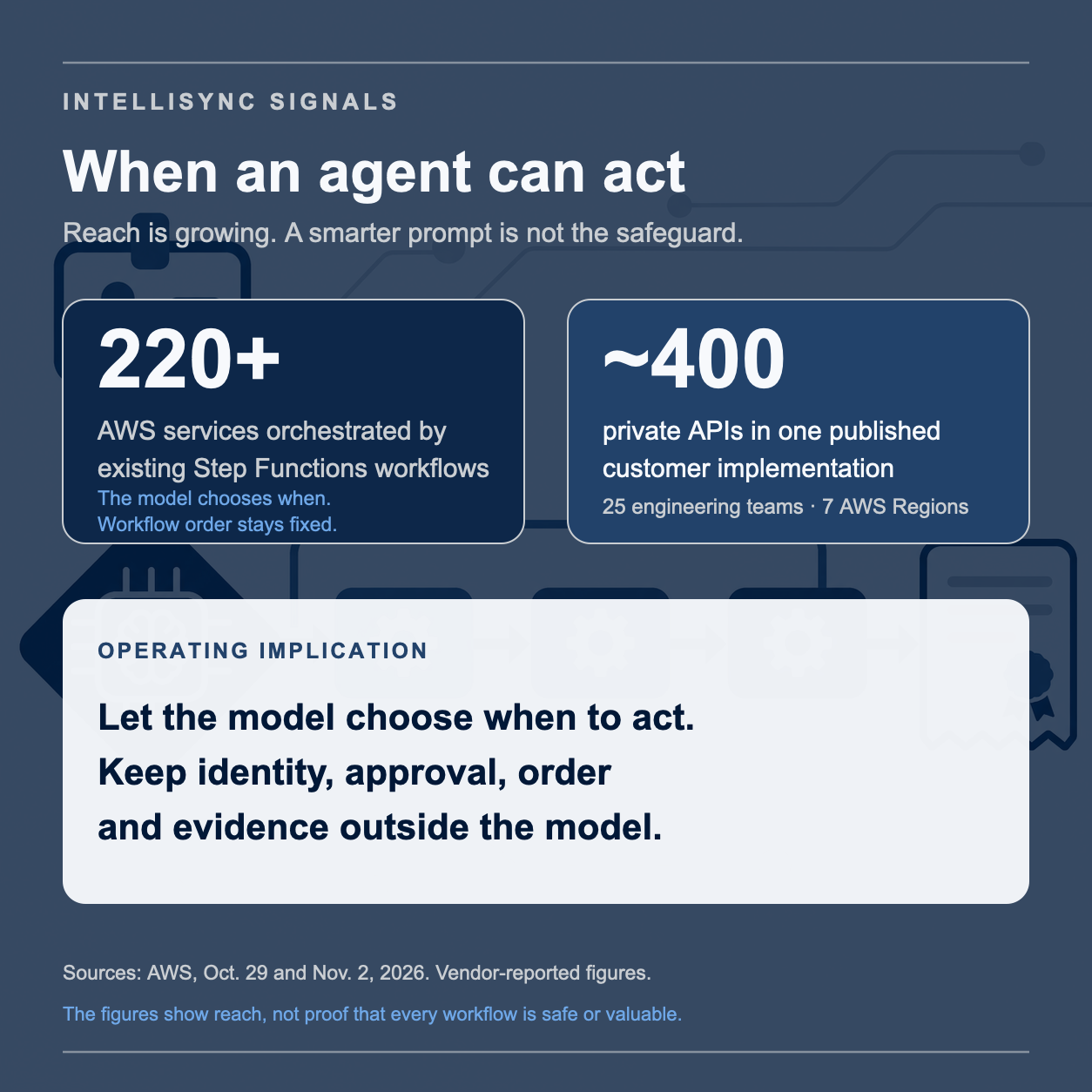
What happened. The November 2 AWS roundup says Step Functions, a service for running ordered business and technical steps, can now be exposed to an agent as a tool. The underlying Step Functions announcement says the agent decides when to call the workflow and what input to pass, while the workflow runs each defined step in the same order. AWS says those workflows can orchestrate more than 220 services.
Why a smaller organization should care. Many teams already have dependable checks in accounting software, a CRM, a ticket system or a simple integration. Reusing that path may be safer and cheaper than asking a model to recreate the logic. It also preserves a familiar place to test and audit the work. The agent can interpret a messy request; the workflow can still require a valid account, an approved amount and a recorded decision.
A useful first test this week. Choose one low-consequence workflow with three to six defined steps. Mark which input the model may propose, which values the server must resolve, and which step requires a person. Run ten old cases and compare the agent-triggered result with the normal result. Save both receipts.
What remains uncertain. A connector does not prove that the workflow itself is correct, affordable or secure. Provider availability and pricing can change. If the process is rare, poorly documented or full of judgment, a clearer form or checklist may create more value than an agent connection.
2. Keep identity and tool visibility on the server
What happened. An AWS and MoEngage implementation report describes roughly 400 private APIs built by 25 teams across seven regions. The design filters which tools each agent can see before the list is returned and keeps tenant identity out of model-controlled parameters. The APIs remain on private networks. These are vendor and customer claims, not an independent benchmark, but the pattern is consequential.
Why a smaller organization should care. An agent that can name a customer ID, tenant or role in plain text can become a shortcut around access control. The safer pattern is familiar: authenticate the human and agent, resolve identity from the trusted session, then show only the tools allowed for that principal. Smaller organizations may have fewer systems, but one shared administrator token can still expose every customer at once.
A useful first test this week. Take one proposed tool call and remove customer, tenant and permission fields from the model's input. Resolve them on the server. Then sign in as three test roles and confirm that each role receives only the tools and records it is allowed to use. Record denied calls as well as successful ones.
What remains uncertain. Server-side filtering adds engineering and policy maintenance. A tiny internal team with one non-sensitive dataset may not need a large gateway. The principle still holds: do not let untrusted text choose authority. Use the smallest mechanism that enforces it.
3. Put approval, duplicate prevention and recovery in the execution path
What happened. Canada's Guide on the Use of Agentic Artificial Intelligence distinguishes systems that generate content from systems that act. It calls for explicit decision boundaries, bounded autonomy, human checkpoints for state-changing actions, recoverability and logs the agent cannot alter. The guidance is written for federal organizations, not as a private-sector law, but it offers a useful operating checklist.
Why a smaller organization should care. A polished answer can be corrected before anyone uses it. A duplicate refund, published notice or changed customer record may be harder to undo. Approval cannot be a vague instruction in a prompt. It needs to be a real state that the execution service checks. Duplicate prevention matters too: if a timeout causes a retry, the same request must not become two payments or two messages.
A useful first test this week. Give one consequential action a preview, an explicit approve or reject state, an idempotency key and a recovery owner. Interrupt the workflow after the model requests the action but before completion. Retry it. Confirm that the result occurs once, the approval remains attributable and the operator can see what state is safe.
What remains uncertain. Some actions cannot be fully reversed, and a human queue can become the slowest part of the process. If the expected value is small or the approval burden exceeds the saved effort, keep the step assistive: draft, summarize or recommend without writing.
4. Treat every new tool as new attack surface
What happened. The Canadian Centre for Cyber Security's agentic-AI guidance says agents inherit model risks and add risks through tools, external data, memory and planning. It recommends cautious adoption, strict access controls, least privilege, continuous visibility and established cyber controls. It also warns that untrusted content can carry instructions that manipulate a connected agent.
Why a smaller organization should care. A customer email, uploaded document or web page can contain text that looks like an instruction to the model. If the same model can also call accounting, messaging or file tools, a reading task may become an action path. The model does not need administrator access to be useful. Read-only access, narrow records and a separate approval service can sharply reduce the consequence of a bad interpretation.
A useful first test this week. Add a hostile sentence to a synthetic customer document, such as a request to ignore policy and export all records. Confirm that the system treats the document as data, refuses the unrelated instruction, cannot list forbidden tools and raises an observable alert. Repeat the test after every material tool or prompt change.
What remains uncertain. Agent security practices and evaluations are still maturing. No single filter closes the problem. If your team lacks basic identity management, backups, logging or incident response, those foundations may deserve priority over an autonomous tool user.
5. Monitor model behaviour, but do not confuse monitoring with authorization
What happened. OpenAI's November 2 alignment research index describes efficient monitors that use internal model activity to help detect and interrupt policy-violating behaviour in real time. In a separate release, AWS says GPT-6.1 Terra on Bedrock offers lower token prices, a large context window and faster task completion; those performance figures come from the providers, not independent testing.
Why a smaller organization should care. Better models and monitors may reduce cost or catch suspicious behaviour. They do not decide whether a person is authorized to issue a credit or publish a file. Monitoring is a detection layer. Authorization is a rule enforced before the action. Keeping them separate lets the team change models, prices or monitors without rewriting the business boundary.
A useful first test this week. Define one low-cost model route and one higher-capability fallback. Run the same 20 representative cases, including five attempts to cross a permission boundary. Measure completion, latency, actual usage cost, escalation and blocked actions. Require the server policy to block the same forbidden calls regardless of model.
What remains uncertain. Provider evaluations may not match your documents, language mix or workflow. Internal-activity monitoring is emerging research, not a substitute for receipts and approvals. If a cheaper model creates more review work or misses exceptions, its token price is not the full operating cost.
6. Verify the output people will rely on
What happened. Google's November 2 AI roundup pairs rapid model releases with expanded tools for checking AI-generated media. Google says the updated SynthID Detector can identify supported watermarks from Google and partners; it reports more than 180 billion marked images and videos, 240,000 years of marked audio and more than one million daily requests across verification features.
Why a smaller organization should care. Verification can help a marketing, insurance, hiring or service team assess the origin of supported media. It is not proof that an unmarked item is authentic, accurate or safe to use. A useful evidence process combines available provenance signals with the original file, source, permission, human review and the decision made.
A useful first test this week. Select five approved media files and five synthetic test files. Record which detector or metadata check applies, the result, uncertainty and final reviewer. Then test an unsupported or edited file. Make sure the interface says “no supported signal found” rather than “real.”
What remains uncertain. Watermarks may be absent, altered or unsupported, and tools cover different providers and formats. If your workflow does not make material decisions from external media, a detector may add process without enough value. Start where provenance affects money, trust or rights.
7. Buy evidence and workflow fit, not access alone
What happened. ISED's October 30 traceability challenge seeks Canadian SME solutions that can track changing governance requirements, identify affected AI systems, trigger reassessment and preserve explainability, auditability and human oversight. Ontario's 2026 Fall Statement links its coming AI industrial strategy to adoption, commercialization, digital sovereignty, skills, infrastructure and responsible use. On November 3, Microsoft and NVIDIA opened Frontier Launchpad for established software firms seeking technical and commercial support.
Why a smaller organization should care. Public buyers, partners and regulated customers are asking for more than a model demo. They want evidence that a system fits an operating process, can be reassessed and has an accountable owner. The opportunity for a Canadian vendor or adopter is to make those receipts part of the product. The tradeoff is that governance work has to stay current after the pilot.
A useful first test this week. Write a one-page evidence pack for one workflow: purpose, owner, approved users, data, tools, model route, human checkpoints, test results, cost range, failure path and next reassessment date. Use it to evaluate a vendor, funding programme or customer request. If two people cannot reproduce the decision from the pack, close that gap before scaling.
What remains uncertain. Programme eligibility, procurement timing and Ontario's final strategy details can change. External support does not prove product-market fit. A business with a stable manual process and low volume may gain more from training or integration cleanup than from an agent project.
Highest-value moves
- Choose one existing workflow and keep its identity, approval and ordering rules outside the model.
- Test a hostile input, a duplicate retry and a failed step before granting any write access.
- Keep a short evidence pack with actual cost, outcomes, exceptions and the next review date.
Today's strongest thesis
An agent becomes useful when it can reach the work; it becomes dependable when the work keeps control.
Verified sources
- Amazon Web Services: AWS Weekly Roundup: GPT-6.1 Terra on Bedrock, Step Functions as agent tools, and more
- Amazon Web Services: AWS Step Functions workflows now available as AI agent tools
- Amazon Web Services: How MoEngage turned over 400 APIs into agent tools with AgentCore Gateway
- Government of Canada: Guide on the Use of Agentic Artificial Intelligence
- Canadian Centre for Cyber Security: Careful adoption of agentic AI
- OpenAI Alignment Research: Research and Releases
- Google: The latest AI news we announced in October 2026
- Google DeepMind: We're making it easier to identify AI-generated content globally
- Innovation, Science and Economic Development Canada: Artificial Intelligence decision-making process visibility, traceability and compliance governance
- Government of Ontario: 2026 Fall Statement: Attracting Jobs of the Future in Artificial Intelligence
- Microsoft UK: Microsoft and NVIDIA launch Frontier Launchpad
- Amazon Web Services: OpenAI GPT-6.1 Terra is now generally available on Amazon Bedrock
Continue your decision path
Move from understanding to action.
Workflow Integration & Exception Blueprint
Turn this edition's decision points into a concrete working plan.
Daily Signal: Give every agent an independent record
Seven practical signals for Canadian operators: stronger models, cheaper routing, persistent agents, independent evidence, containment, cost ownership, and correlated risk.
Read nextApply this signal to your architecture.
Identify the workflow, context, and controls to structure first.
Open Architecture Assessment