Operating question
As AI produces more plausible work at lower cost, Canadian SMEs can create value by limiting review queues, measuring accepted results and keeping authority explicit.
Decision Architecture
The Review Queue Became the Work
For
Leaders and workflow owners
You will leave with
4 operating decisions
Reading mode
12 min · 10 verified sources
Reading guide9 sections · Canadian briefing+
Highest-value moves
- 01Set a maximum review queue before increasing AI-assisted output.
- 02Route model effort and promotional credits by accepted results, not vendor benchmarks.
- 03Give every finding, connector and funded pilot a named owner and stop condition.
- 04Use simulations and scans to expose exceptions, then verify fixes in the real workflow.
AI is multiplying drafts, scans and connected actions. Canadian SMEs can gain more by sizing review capacity and acceptance rules before adding volume.
Today's strongest signal: AI can now create more plausible work than a small team can responsibly review, so the scarce resource is a clear acceptance decision.
A twelve-person software firm can ask an agent to prepare a fix, another agent to scan the repository and a third system to choose the model. A manufacturer can test an interactive simulation before touching a machine. A Prairie business may qualify for expert help to build its first production use case. These are real openings. They also create a less glamorous question: who decides that the result is ready, based on what evidence, and what work waits while that person checks it?
The strongest developments from the preceding 72 hours point in the same direction. GitHub reported a sharp rise in agent-started pull requests and released more automation, routing and scanning tools. Google and Anthropic disclosed stronger AI capabilities for finding and exploiting software flaws. OpenAI and ServiceNow connected conversational work to operational records. Amii expanded a Canadian adoption program with limited capacity. Google introduced a world model for interactive simulation. Each signal makes production easier. None makes judgment, authorization or accountability automatic.
The opportunity is to let a small team prepare more options, find defects sooner and rehearse change before committing money or authority. The tradeoff is a larger queue of convincing outputs that still need review. A realistic reason not to adopt a new capability is that the team has no owner for the result, no stable reference set or no time to investigate exceptions. In that case, adding generation can increase unfinished work instead of reducing it.
Illustrative scenario: A 35-person metal fabricator wants to reduce quoting time. An assistant extracts dimensions from customer files and drafts a bill of materials. It cannot send a quote, change a price or create a purchase order. The estimator reviews 40 historical jobs, including eight held-back cases with unclear drawings and rush surcharges. The team measures accepted drafts, corrections, elapsed review time and missed exceptions. Straightforward jobs improve, but the assistant creates too many plausible guesses on custom finishes. The owner narrows the trial to standard materials and keeps custom jobs manual. This scenario is illustrative, not a reported case.
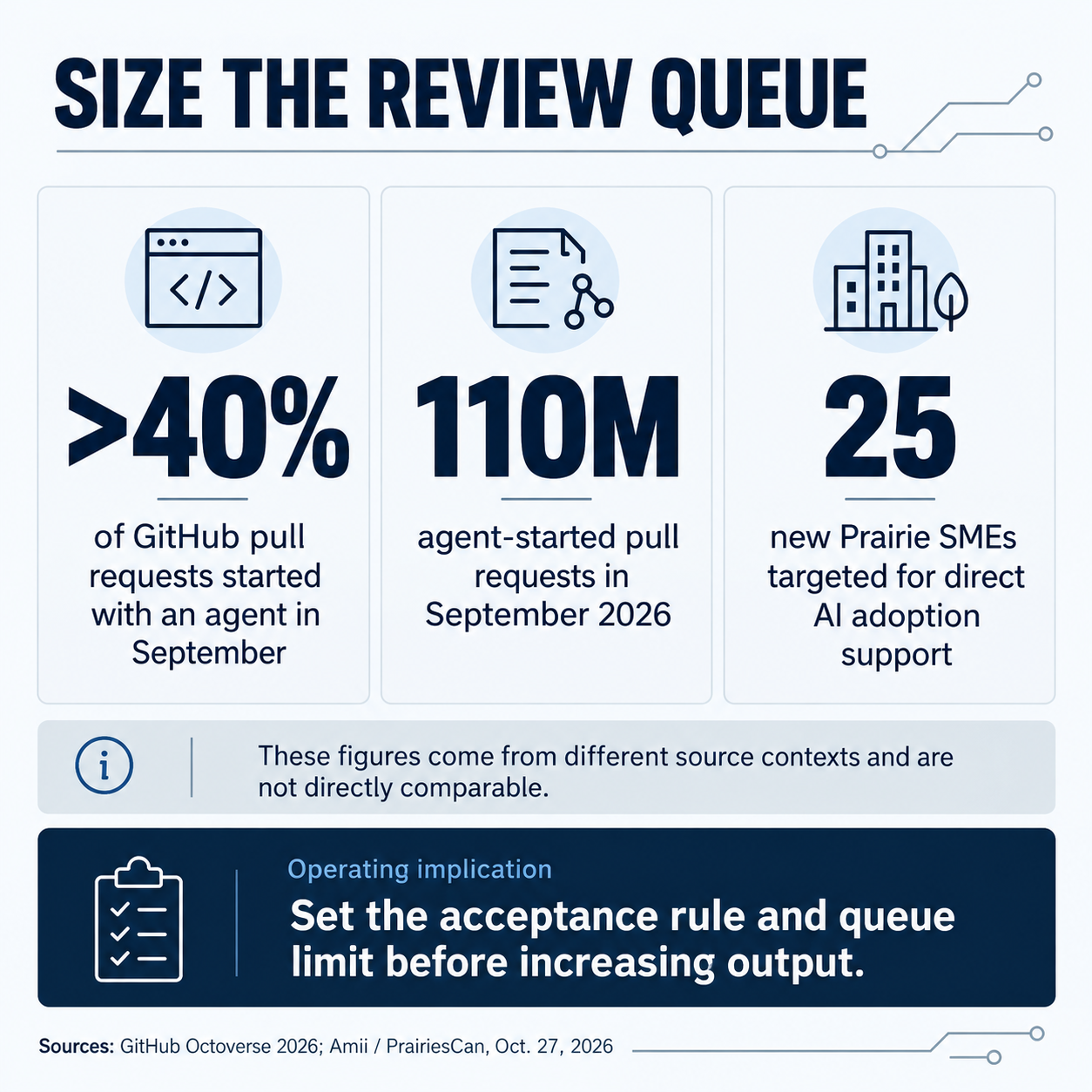
1. Size the review queue before increasing the output
What happened. GitHub's 2026 Octoverse report says developers started more than 40% of pull requests with an agent in September, up from 17% in March, for 110 million agent-started pull requests that month. GitHub defines this as a pull request whose first draft came from a coding agent it can detect. The same report says 90% of agent-involved pull requests merged within two weeks by September, compared with about 86% for the comparison group. GitHub's Universe announcement frames completed software, rather than more code, as the useful output and introduces deeper review for higher-risk changes.
Why a smaller organization should care. The figures are not a promise that an agent will improve your software. They show how quickly draft volume can rise once starting work becomes easy. A small development or digital team may save hours on preparation and then lose them to review, rework and coordination. The opportunity is to move repetitive setup out of the critical path. The tradeoff is that the most experienced person can become the bottleneck.
A useful first test this week. Choose one class of low-consequence change, such as documentation, a test repair or a small internal form. Limit the trial to five changes. Record preparation time, review time, defects found after review, changes rejected and the reason for each rejection. Set a maximum queue length. If three items are waiting, pause new generation until one is accepted or closed.
What remains uncertain. GitHub's aggregate covers many organizations, repositories and agent products. Merge speed does not prove that a change was useful or defect-free. If the team lacks automated tests, a named reviewer or a rollback path, more pull requests may simply create more inventory.
2. Route effort by the result you need, not the model menu
What happened. GitHub made Copilot Fusion generally available with single-model, cascade and critique routes. GitHub says its highest effort option scored within two points of a leading coding agent on one benchmark while using about half the average API cost and tokens and taking about 40% less time per task. Those are vendor-reported benchmark results, not a guarantee for a local workflow. Users are billed for each model the route uses, and the current discount is explicitly temporary.
Why a smaller organization should care. Model routing means the system can spend more effort only when a quality check calls for it. The opportunity is a better cost per accepted result without asking every employee to become a model expert. The tradeoff is less visibility into which route handled a case and a risk that a temporary discount hides the steady-state cost.
A useful first test this week. Take 30 completed examples from one task. Compare a simple fixed route with an automatic route. Measure accepted results, corrections, time and actual usage cost. Record the undiscounted price before the trial begins and stop when the budget or error threshold is reached.
What remains uncertain. Routing behaviour, eligible models and discounts can change. A benchmark for coding agents may not match a proposal, customer reply or data-cleaning task. If the team cannot retrieve route and usage records, a simpler fixed model may be easier to explain and govern.
3. Assume the patch window is getting shorter
What happened. Google announced Gemini 4 Carbon for a limited group of cyber defenders. Google reports strong results for vulnerability finding, exploitation and patching, while keeping the initial rollout restricted. Anthropic separately reported five attack chains built with an unreleased research model across Chrome, Safari, Android, Windows and Linux. It says the affected vendors received coordinated disclosure and fixes before detailed publication. Microsoft's current security guidance cites more than 46 million business-identity impersonation attacks and emphasizes access limits, verification and human control.
Why a smaller organization should care. Advanced vulnerability work is becoming faster for defenders and, eventually, for attackers. A small firm does not need a frontier cyber model to respond. It needs to know which internet-facing systems it owns, who patches them and how quickly a critical update can be applied. The opportunity is faster discovery and remediation. The tradeoff is more alerts, possible false positives and pressure to change systems without enough testing.
A useful first test this week. List every public website, remote-access service, cloud administrator and business email domain. Give each an owner, a patch or configuration check date and a recovery contact. Pick one critical service and rehearse the path from vendor alert to tested update. Use a separate channel to verify urgent payment, password or access requests.
What remains uncertain. Vendor evaluations use selected tasks and controlled conditions. They do not reveal when similar capabilities will be broadly available or how attackers will use them. If a provider manages the underlying service and patches it automatically, the highest-value move may be identity protection and recovery testing rather than buying another scanner.
4. Make a security scan produce a decision, not just a list
What happened. GitHub released AI Scan for repositories in public preview. The agentic scanner examines the latest default-branch commit within a fixed time budget, skips issues already reported by CodeQL when both are enabled and places findings in the existing code-scanning backlog. Usage consumes security AI credits, and organizations can set a budget. A rescan is required to verify and close a finding after a fix.
Why a smaller organization should care. Whole-repository scanning may find problems outside a recent change or in languages not covered by a rule-based tool. The useful part is not the scan itself; it is the path from finding to owner, evidence, fix and verification. The tradeoff is a larger backlog and paid usage. A realistic reason to wait is that the organization already has unresolved high-priority findings or does not have someone able to validate an AI-generated report.
A useful first test this week. Run the preview, or an equivalent tool already available to you, on one non-production repository with a fixed budget. Ask a qualified reviewer to classify each finding as confirmed, uncertain or not reproducible. Fix one confirmed issue, rerun the scan and save the before-and-after evidence. Do not let the tool write directly to production.
What remains uncertain. The feature is in preview, coverage varies by language and a model can miss a flaw or report one that is not reachable. A clean result is not proof of security. If the code is small and conventional, existing dependency, secret and static-analysis checks may provide a cheaper and more repeatable baseline.
5. Give remembered instructions an owner and an expiry
What happened. GitHub made Copilot Memory generally available on paid plans and introduced a preview that can propose updates to repository memories, skills and instruction files. GitHub reports that, in reviewed preview sessions where memory was used, 93% showed better adherence to developer preferences and 42% showed more efficient workflows attributed to the included memories. The product can create personal and repository memories across several clients, and administrators receive controls over availability.
Why a smaller organization should care. Reusable instructions can stop a team from repeating the test command, brand rule or review checklist in every request. They can also preserve an outdated approval limit or a shortcut that no longer applies. The opportunity is more consistent work. The tradeoff is a new kind of configuration that changes quietly and influences many future results.
A useful first test this week. Write one repository or workflow instruction that is stable, specific and easy to verify, such as the exact test command and what a passing result means. Give it an owner and review date. Change the command in a test branch and confirm the assistant surfaces the conflict instead of relying on the older memory.
What remains uncertain. GitHub's preview review is vendor-reported and does not show how memory behaves in every repository or over a long retention period. If instructions change often or the team cannot inspect and delete them, explicit versioned files may be safer than autonomous memory.
6. Arrive at funded adoption with a measurable job
What happened. Amii announced an expansion of its Prairie AI adoption program with more than $5.6 million in total federal support and capacity to work directly with 25 new SMEs. Initial work spans energy, agriculture and manufacturing in Alberta, Saskatchewan and Manitoba, and Amii says limited capacity remains. The initiative is funded through Prairies Economic Development Canada.
Why a smaller organization should care. Expert and public support can reduce the cost of turning a real workflow into a tested system. The limited number of direct engagements also means a vague request for “an AI strategy” is harder to evaluate than a specific operating problem. The opportunity is access to technical depth and a safer path through early design. The tradeoff is staff time, data preparation and the risk of building a pilot that no process owner can maintain.
A useful first test this week. Prepare a one-page problem brief whether or not your business is eligible. Name the job, current volume, delay, error cost, data owner, affected people, acceptable result and the person who can approve a change. Include a baseline and one held-back test set. That brief is useful for a funding conversation, an advisor or an internal decision.
What remains uncertain. Program fit, selection, timing and contribution terms require direct confirmation. The announcement does not promise funding or a successful deployment for every applicant. If the workflow is rare, poorly documented or blocked by missing records, ordinary process improvement may create more value first.
7. Use simulation to rehearse the exception, not to sell the demo
What happened. Google introduced Genie 4 as a research world model for real-time interactive simulation with native audio. Google says users can steer events through natural language and identifies possible uses in safe training environments for robots and agents, manufacturing and creative work. Access is starting with trusted testers, with wider product and API availability described as coming later.
Why a smaller organization should care. Interactive simulation may eventually let a team rehearse a warehouse change, safety procedure, customer setting or equipment layout without interrupting live work. The opportunity is inexpensive variation and early discovery of edge cases. The tradeoff is that a convincing simulation can still omit friction, physics, human behaviour or local constraints. It is evidence about a modelled environment, not proof about the real one.
A useful first test this week. Do not wait for this product. Choose one planned change and run a tabletop simulation with the people who do the work. Introduce three exceptions: missing data, unavailable equipment and an unauthorized request. Record who notices each problem, what evidence they use and how the process returns to a safe state.
What remains uncertain. Genie 4 is limited research access, and the announcement does not establish price, regional availability or accuracy for a Canadian SME's setting. If a paper walkthrough exposes obvious gaps, a generated simulation would add polish before it adds value.
Highest-value moves
- Set a maximum review queue for one AI-assisted workflow and pause new generation when it is full.
- Give every tool connection, security finding and funded pilot a named owner, acceptance rule and stop condition.
- Measure accepted results and exception time before expanding volume, credits or authority.
Today's strongest thesis
When output becomes cheap, the advantage moves to the team that can accept, reject and stop work without guessing.
Verified sources
- GitHub: Octoverse: Commits, pushes, reach new highs in 2026 as developers build with agents
- GitHub: GitHub Universe 2026: Evolving every layer of the stack
- GitHub Changelog: Route and orchestrate models with GitHub Copilot Fusion
- Google: Gemini 4 Carbon: our next frontier model
- Anthropic: Discovering and exploiting vulnerabilities in critical, real-world software with Claude
- Microsoft Source: Microsoft: 5 Digital Habits You Need to Change to Combat Increasingly Sophisticated Cyber Threats in the AI Era
- GitHub Changelog: AI Scan for repositories in public preview
- GitHub Changelog: GitHub intelligence puts your code, context, and history to work
- Alberta Machine Intelligence Institute: Amii and PrairiesCan Expand Successful AI Adoption Program Across the Prairies
- Google DeepMind: Introducing Genie 4
Continue your decision path
Move from understanding to action.
Daily Signal: Make accepted work grow faster than the queue
Seven practical signals for Canadian operators: accepted findings, deterministic tool checks, narrow permissions, drift benchmarks, agent ownership, voice consent, and funding readiness.
Read nextApply this signal to your architecture.
Identify the workflow, context, and controls to structure first.
Open Architecture Assessment