Operating question
When AI work has a real deadline but no one is waiting at the screen, the cheapest trustworthy route may be slower by design and stronger on ownership, review, and evidence.
AI Operating Models
Daily Signal: Stop paying rush rates for work that can wait
For
Leaders and workflow owners
You will leave with
4 operating decisions
Reading mode
11 min · 9 verified sources
Reading guide9 sections · Canadian briefing+
Highest-value moves
- 01Classify AI work by urgency and consequence before paying for an instant response.
- 02Measure accepted outputs and reviewer time before increasing generation volume.
- 03Keep reusable memory scoped, sourced, dated, and removable when workflows change.
- 04Attach trust to a specific knowledge version and maintain a plain-language AI register.
Seven practical signals for Canadian operators: faster models, delayed AI pricing, review capacity, reusable memory, current knowledge, AI registers, and disciplined funding.
Today's strongest signal: some AI work gets cheaper when you stop asking it to behave like an instant reply. Picture the familiar Friday-afternoon request: review 200 support tickets, compare a folder of contracts, or prepare a Monday exception list. Nobody is waiting at the screen. The result needs to be ready, reviewable, and correct—not delivered in twelve seconds.
This edition follows seven signals from the preceding 72 hours. Together they suggest a practical change for Canadian SMEs: sort work by urgency, consequence, and proof before choosing the model or agent. Faster models widen the menu. They do not make every task urgent, nor do they remove the need for a person who owns the result.
1. A faster frontier model still needs a local acceptance test
Google introduced Gemini 4 Neon on November 18 for complex software, knowledge, and science work. Google reports a one-million-token context window, four thinking levels, and availability through its API and business products. It also presents benchmark and cost-per-task results. Those are useful vendor signals, not a Canadian firm's acceptance test. The launch details make the opportunity visible; your own cases establish the fit.
A useful first test is 40 past vendor questionnaires, service summaries, or spreadsheet reviews with known approved results. Compare the new model with your current route on accepted outputs, material errors, time, and total cost, including human correction. Keep the prompt, tools, and acceptance rule fixed so you are testing the model rather than changing three things at once. If your team handles both official languages, include ordinary French and English cases rather than translating a clean English test after the fact.
The opportunity is to move more demanding analysis into a faster route. The tradeoff is a fresh evaluation burden and the temptation to treat a large context window as permission to send every file. A realistic reason not to adopt Neon now is that your current model already meets the target, or your volume is too low for migration and retraining to pay back.
What remains uncertain is performance on your mix of incomplete records, PDFs, spreadsheets, and staff habits. A benchmark can point toward a test. Your accepted-case set decides whether the route is ready.
2. Delay can now be an explicit cost control
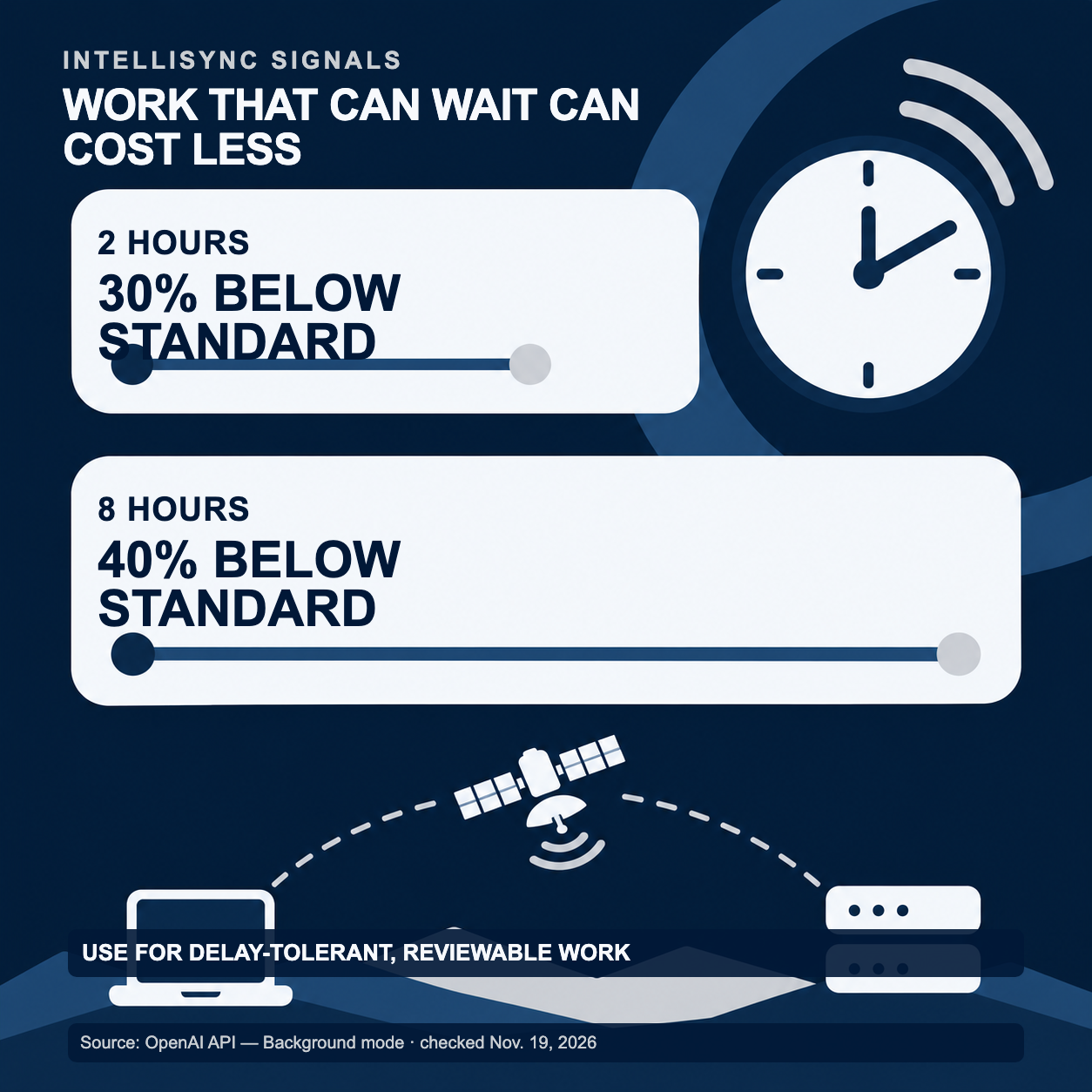
OpenAI's current Background mode documentation offers two discounted completion windows for supported models: a two-hour target at 30% below Standard model-token rates and an eight-hour target at 40% below Standard. The work runs asynchronously, meaning the request continues without an open live connection. The documentation also says requests can use webhooks, can be cancelled while in flight, and temporarily store response data even when storage is otherwise disabled or Zero Data Retention applies.
For a Canadian SME, the practical move is to separate customer-facing latency from internal completion time. A support reply may need seconds. An overnight document review, morning queue classification, or weekly reconciliation may not. A useful first test is one repeatable batch with a clear deadline and no immediate downstream action. Run it in the ordinary route and in the delayed window. Measure completion reliability, accepted results, total cost, and the time a person spends handling failures.
Illustrative scenario: a 28-person insurance brokerage receives policy-change documents throughout the day. At 6 p.m., a background job extracts a proposed exception list for the next morning. A licensed person reviews every item before any client record changes. The value comes from a ready queue, not from pretending the agent is the broker.
The opportunity is lower model cost and less pressure on interactive capacity. The tradeoff is delayed feedback, webhook or polling logic, expiry handling, and the stated temporary-storage boundary. A realistic reason not to use a delayed window is that a person truly waits on the result, the data cannot enter that storage mode, or failure would be discovered too late to recover.
What remains uncertain is queue time under real load and whether follow-up tool calls preserve the expected economics. Set a deadline and a failure path; “eventually” is not a service level.
3. More generated work can make review slower
Google's November 18 account of Sashiko, its agentic Linux code-review system, starts with an uncomfortable point: code generation is not the only bottleneck. More plausible patches can pile up in front of the same experienced reviewers. Google reports that patches merged despite a critical Sashiko warning needed a later fix 7.6% of the time. The system uses focused checks rather than one vague instruction.
The lesson travels beyond software. If your team uses AI to produce proposals, policies, reconciliations, marketing claims, or customer summaries, output can grow faster than qualified review capacity. Count three things for one workflow: items produced, items accepted without material correction, and reviewer minutes per accepted item. If production doubles while accepted throughput stays flat, the agent moved the queue rather than improving the work.
Google's separate guide to durable agentic loops recommends locking the specification, plan, and executable tests before longer work runs. In a non-technical workflow, an executable test can be a deterministic total, a required field, a policy lookup, or a comparison with the source record.
The opportunity is to let automation perform narrow, repeatable checks before a person sees the result. The tradeoff is designing those checks and handling false alerts. A realistic reason not to automate review is low volume or a task where an experienced person already works quickly and the exceptions depend heavily on context.
What remains uncertain is your actual reviewer capacity. Measure the accepted unit, not the number of drafts the system produced with enthusiasm.
4. Reusable experience can reduce cost, but stale memory adds risk
Microsoft Research published TokenEconomizer on November 16. Across 277 software bug-fixing tasks, the researchers report average cost reductions of 18.4% to 30.9% across several agent-model combinations while task success stayed broadly stable. The system learns repository-specific notes, removes tools that history suggests are unlikely to be used, and intervenes when an agent repeats a failed approach. Early tasks can cost more while the system learns.
The broader signal is not “install this coding plugin everywhere.” Repeated workflows contain reusable operating knowledge: where the approved template lives, which test catches the common defect, which tool is actually needed, and which failed route can be skipped. A useful first test is a short, owned memory file for one recurring process. Record only confirmed instructions, their source, last-checked date, and the condition that retires them. Review changes before they become default context.
The opportunity is less rediscovery and fewer unused tools. The tradeoff is maintaining memory as the business changes. A realistic reason not to add persistent memory is a sensitive or fast-changing workflow where yesterday's shortcut could cross a customer, tenant, legal, or authorization boundary today. Retrieve current instructions from the authoritative system each time.
Keep scope narrow. A note learned in one client folder does not belong in another. A past failure is evidence about one route, not proof that the route will always fail. The best reusable context is small enough to inspect and specific enough to invalidate.
What remains uncertain is whether the reported savings transfer outside software. Compare repeated steps and correction time before and after a small, reviewed memory layer.
5. Knowledge needs a current trust state, not a permanent gold star
Google released version 0.3 of the Open Knowledge Format on November 18. OKF uses Markdown and YAML to package knowledge for agents. The update adds conformance rules, provenance, licensing, lifecycle information, and trust tiers that change when an agent edits previously reviewed content. In Google's example, a human-reviewed definition no longer carries that same review state after an agent changes the text.
Canadian SMEs do not need to adopt a new specification to use the principle. A policy, price list, procedure, or metric definition needs fields for owner, source, effective date, last meaningful change, review state, and expiry. A useful first test is one knowledge set that already feeds an assistant. Add those fields, then change one item and confirm that the system marks the old review as stale instead of carrying it forward.
The opportunity is safer reuse across tools and vendors. The tradeoff is metadata work and the possibility of creating a catalogue nobody maintains. A realistic reason not to build a formal knowledge layer is that the source system already provides versioning, ownership, and approval history. Link to that authority rather than copying it into a second place.
This matters in bilingual operations. A revised English policy does not automatically validate the French version. Track locale, equivalence review, and effective date separately while keeping the pair atomic for release.
What remains uncertain is whether OKF itself will become widely adopted. The durable move is independent of the format: trust attaches to a specific version, and a meaningful edit changes the review state.
6. Canada's AI register feedback is a practical design review
The Treasury Board of Canada Secretariat published its What We Heard report on the federal AI Register on November 18. Respondents valued public disclosure and the decision to release a minimum viable product, but raised concerns about usability, inconsistent data, accessibility, bilingual navigation, risk information, the role of AI in decisions, data use, recourse, and accountability. The government's progress page says the feedback will inform a regularly updated replacement.
A smaller organization can use that list before buying governance software. Create a plain-language register with one row per AI-enabled workflow: business purpose, owner, users affected, data used, provider, decision role, human review, correction path, last evaluation, and current state. A useful first test is the workflow most likely to surprise a customer or employee. Ask someone outside the project whether the row explains what the system does and who can correct the result.
The opportunity is an inventory useful to procurement, privacy, security, customer service, and leadership. The tradeoff is that a register becomes misleading if nobody maintains it. A realistic reason not to publish the full register is that it could expose security details or unvalidated claims. Start internally, separate public transparency from protected configuration, and define the update trigger.
The report also discloses that generative AI helped draft parts of the document, employees reviewed and validated all content, and no personal consultation information was processed by the tool. That is a useful pattern: state the role of AI, the data boundary, and the accountable reviewer.
What remains uncertain is the replacement register's design. You do not need to wait. A small current inventory is more useful than a polished catalogue of last quarter's systems.
7. Funding deadlines reward a defined project, not a rushed purchase
The Atlantic Canada Opportunities Agency's Regional Artificial Intelligence Initiative FAQ lists November 20 at 11:59 p.m. Atlantic as the expression-of-interest deadline for its current competitive call. It says projects must request at least $1 million and demonstrate measurable business outcomes. Other regional streams have different eligibility, timing, contribution types, and project-size rules.
For leaders outside Atlantic Canada, the signal is still useful: public funding is moving toward AI adoption tied to defined outcomes, not a general software shopping list. A useful first test is a one-page investment case before any application or vendor conversation. Name the workflow, baseline cost or delay, target outcome, data and integration work, accountable owner, adoption plan, evaluation method, and what continues after funding ends.
The opportunity is to accelerate a well-scoped adoption or commercialization project. The tradeoff is reporting, procurement, cash-flow timing, and a project shape that may be larger than the problem. A realistic reason not to apply is simple: if the minimum request, deadline, or eligible-cost rules force you to inflate a modest experiment, do the smaller experiment first. Funding can reduce capital pressure; it cannot make an unclear workflow valuable.
If your team is eligible and already has the evidence, confirm the current program page and speak with the agency. Do not treat this briefing as eligibility advice. Keep authorization, customer data, and production changes behind the same acceptance gates you would use without a grant.
What remains uncertain is selection, timing, and the final contribution agreement. Build the project so the business case can stand without assuming approval.
Highest-value moves
- Split one AI workload into “someone is waiting” and “ready by a deadline,” then test the delayed route only on the second group.
- Measure accepted outputs and reviewer minutes for one high-volume workflow before increasing generation volume.
- Create one current AI-register row with an owner, data boundary, decision role, review state, and correction path.
Today's strongest thesis
The cheapest trustworthy AI route may begin with a clock, but it ends with a clear owner and a reviewable result.
Verified sources
- Google: Introducing Gemini 4 Neon
- OpenAI Developers: OpenAI API Background mode
- Google Cloud: Sashiko agentic code review
- Google Cloud Developer Relations: Durable agentic systems
- Microsoft Research: TokenEconomizer
- Google Cloud Data Analytics: What's new in OKF v0.3
- Treasury Board of Canada Secretariat: Consultations on the AI Register
- Government of Canada Digital Government: Progress on AI in government
- Atlantic Canada Opportunities Agency: Regional AI Initiative FAQ
Continue your decision path
Move from understanding to action.
AI Value Realization Plan
Turn this edition's decision points into a concrete working plan.
Bring a Workflow, Not a Wish List
New Canadian funding, small-business training and connected-agent controls point to one practical move: define the workflow before choosing the opportunity.
Read nextApply this signal to your architecture.
Identify the workflow, context, and controls to structure first.
Open Architecture Assessment