Operating question
If an agent can act, its identity, authority and evidence have to arrive before the action.
Agent Systems
Give Every Agent a Verifiable Identity
For
Leaders and workflow owners
You will leave with
4 operating decisions
Reading mode
11 min · 12 verified sources
Reading guide9 sections · Canadian briefing+
Highest-value moves
- 01Treat agents as delegates and keep customer permissions authoritative.
- 02Measure completed work and mark unavailable evidence explicitly.
- 03Store memory as dated facts and check freshness at action time.
- 04Use hard capacity, security and human-approval boundaries before consequential actions.
Agents are becoming customer and worker channels. Canadian SMEs can start with identity, fresh records, fixed limits, outcome evidence and human approval.
Today's strongest signal: if an AI agent can act for a customer, employee or business, its identity, authority and evidence have to arrive before the action—not after a problem.
Imagine a 45-person Ontario distributor. A customer asks a personal agent to compare stock, negotiate a delivery window and place an order. The distributor's website sees a burst of automated requests from an intermediary. Its inventory system is five minutes behind the warehouse. Its account terms allow one buyer to approve $5,000, but not $25,000. The agent may be helpful, yet the business still needs to know who it represents, what that person authorized, which record was current and who accepted the final commitment.
That ordinary business situation connects the strongest signals from the preceding 72 hours. Cloudflare is making personal-agent traffic visible while the industry works on delegation standards. GitHub is measuring whether AI review comments change the work, and marking gaps where the telemetry cannot support a conclusion. Salesforce is testing memory across changed facts and turning platform capacity into a pipeline contract. Confluent is pushing current business state closer to the moment an agent acts. OpenAI's new cyber model shows why stronger capability needs stricter scope and authorization. Shopify continues to move discovery and checkout into agent surfaces.
The opportunity is not “more autonomy” in the abstract. It is a shorter path from a customer's intent to a completed, verified result. The tradeoff is that identity, fresh records, limits and receipts become product work. A realistic reason not to adopt is volume: if a trusted employee handles five requests a week with little delay, a new agent channel may add more integration and fraud exposure than value.
Illustrative scenario: the distributor creates an agent channel that can read public product data and account-specific availability after the customer authenticates. The agent receives a short-lived delegation token for one account and one task. It may prepare a cart and suggest a delivery window. A person confirms any price exception, credit term or order above the buyer's limit. The receipt records the customer, agent, source versions, approved action and final order number. This scenario is illustrative, not a reported deployment.
1. Treat the agent as a delegate, not anonymous traffic
What happened. On November 5, Cloudflare described the missing trust layer for agents: websites often see an intermediary's requests but lose the user identity, authorization and accountability behind them. It announced a coalition to advance interoperable delegation work. A day earlier, Cloudflare added personal-assistant traffic analytics and per-agent access choices. Site owners can distinguish supported personal agents, inspect paths and errors, and allow or block them separately, while Cloudflare notes that user context and authority remain unresolved.
Why a smaller organization should care. Blocking all agents may turn away customers. Allowing all automated traffic may expose account pages, pricing logic or checkout to abuse. The useful middle is to identify the agent, link it to an authenticated customer when possible and enforce the customer's existing permissions. An agent does not become an owner merely because it can fill a form quickly.
A useful first test this week. Review one week of web and API logs. Separate verified bots, likely automation and known customer sessions. Choose one low-risk path—public catalogue search or support lookup—and write an agent policy with allowed actions, rate limits, required authentication and a clear rejection response. Keep purchase, account change and external communication behind existing authorization.
What remains uncertain. The standards are still forming, and local agents may not have a reputable operator behind them. Vendor detection can misclassify traffic. If agent visits are negligible, better logging may be enough for now; a full delegation layer would be premature.
2. Measure whether AI changes the work, then mark missing evidence
What happened. GitHub added an addressed-rate measure for Copilot code review. It counts whether developers acted on evaluated comments and whether a human later requested changes after an AI review. GitHub also added fields for missing client telemetry and unsupported versions, explicitly saying that unavailable values are not false or zero.
Why a smaller organization should care. Seat activation, prompts sent and suggestions shown are activity. They do not show that a defect was prevented, a quote became accurate or a customer case closed sooner. Worse, an incomplete dashboard can make adoption look weak or strong depending on which events went missing. A small firm usually cannot afford a measurement programme detached from the workflow result.
A useful first test this week. Pick one assisted workflow and define three measures: reach, response and result. Reach is how often the tool appears. Response is whether a person used, changed or rejected its output. Result is the business consequence—rework, cycle time, error rate or completed transaction. Add a fourth state, “evidence unavailable,” for missing logs. Review ten cases, not only the average.
What remains uncertain. Addressing a comment does not prove the comment was correct, and a merge without a later human change request does not prove production quality. Instrumentation has privacy and maintenance costs. For a two-person team, a weekly sample with a simple decision log may be more useful than a complex dashboard.
3. Store customer memory as dated facts, not a persuasive summary
What happened. Salesforce reported that an updated Agentforce memory policy improved recall in an end-to-end evaluation on its live system. The test planted facts across long conversations, changed some facts later, then asked questions that depended on them. Salesforce says the policy recalled 1.8 times as many facts stated directly and 2.2 times as many facts that changed over time. Those are vendor results on its system, not a general benchmark.
Why a smaller organization should care. Customer facts expire. A delivery address, preferred contact, job title or consent choice may be correct in March and wrong in July. A fluent answer hides whether the agent retrieved an old fact, failed to save an update or invented a bridge between them. Memory needs source, date, scope and a rule for correction.
A useful first test this week. Create 20 synthetic customer histories with an original fact, a later correction and a task that depends on the current value. Ask the system to return the answer plus the source event and effective date. Fail the test if it merges conflicting facts silently. Keep sensitive data out of the test and set a deletion path before using real records.
What remains uncertain. Better recall can also retain information that no longer belongs in context. Long-term memory raises consent, retention and access questions. If the workflow already has a reliable CRM field, the safer choice may be to read that field rather than build conversational memory.
4. Ask what is true now before letting the agent decide
What happened. On November 4, Confluent, an IBM company, introduced its Streamhouse architecture. It combines streaming, processing, governance and query access so applications and agents can use a more current view of operational events. Confluent's examples focus on avoiding decisions assembled from systems that updated at different times; its latency and throughput figures are internal platform tests.
Why a smaller organization should care. A model can reason well over stale inventory and still promise the wrong item. It can read yesterday's payment status and chase a customer who already paid. The design question is not whether every table becomes real-time. It is which facts can make an action wrong if they are five minutes, one hour or one day old.
A useful first test this week. Map one decision to its required facts. Write the maximum age for each: stock count, account balance, service status and price. At action time, return the value, source and timestamp. If a critical fact exceeds its limit, route the case to a person or refresh it. Measure how often freshness, not model quality, caused the stop.
What remains uncertain. Streaming systems add cost and operational work. Many smaller workflows are batch-shaped: a nightly export can be sufficient and easier to reconcile. Do not buy real-time infrastructure for a monthly decision; use the smallest freshness mechanism that protects the result.
5. Put capacity limits in the pipeline before the agent writes code
What happened. Salesforce published a governor-limit testing pattern for AI-generated code. Governor limits are hard platform ceilings on resources such as queries, CPU time and memory in a shared environment. The proposed loop measures consumption in tests, warns near a chosen budget, blocks a violation and returns structured feedback to the coding agent.
Why a smaller organization should care. Fast code generation can produce many individually correct changes that collectively exhaust a transaction, API quota or monthly budget. A passing unit test only proves the small fixture worked. Capacity, rate, cost and timeout limits are part of correctness when a workflow serves real customers.
A useful first test this week. Choose the busiest automated path. Record its database calls, external requests, execution time and spend on a representative high-volume case. Set a generous warning threshold and a firm platform maximum. Make the pipeline reject a change that crosses the maximum, and require a named owner to approve any budget increase.
What remains uncertain. Thresholds that are too tight create false alarms and slow useful work. Tests cannot reproduce every external latency or concurrency pattern, so production monitoring still matters. If the application is low-volume and the platform already enforces a safe ceiling, a small alert may be enough.
6. Treat stronger cyber capability as a shorter repair window
What happened. OpenAI added GPT-6 Cyber to its API changelog for authorized vulnerability investigation, reproduction in a test environment and fix verification. Its system card reports 48.5% on ExploitGym versus 32.1% for GPT-5.6 Cyber, and 99.93% avoidance of out-of-scope services without a deployment prompt, rising to 100% with one. The card classifies the model Critical in cybersecurity and restricts access through identity verification, single sign-on, multi-factor authentication and IP allowlisting.
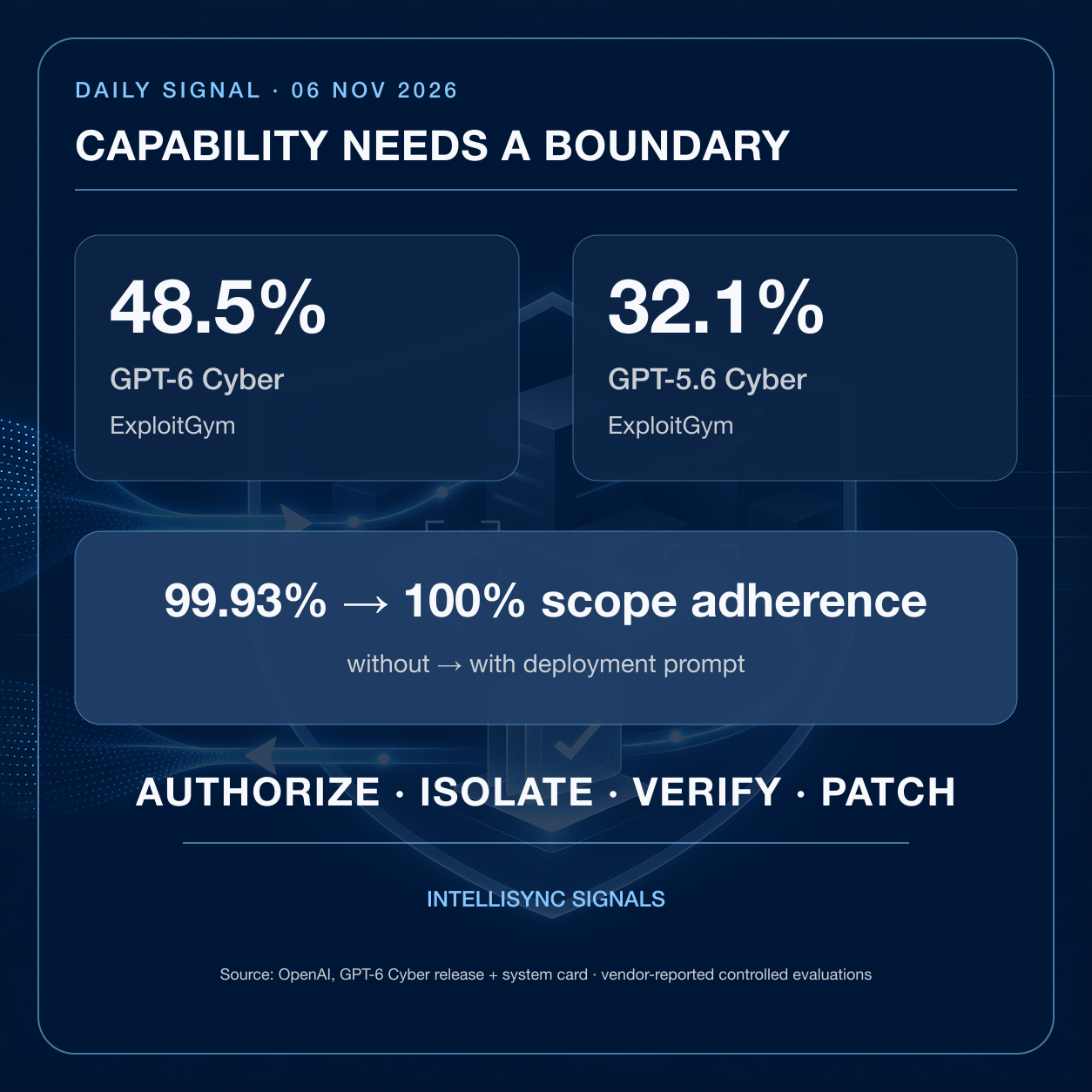
Why a smaller organization should care. The practical message is not to buy an offensive model. It is that finding and validating flaws is getting faster for defenders and potentially for attackers. A vulnerability backlog that once waited for a quarterly review may need a tighter owner, proof standard and patch path. Authorization and isolation remain firm requirements.
A useful first test this week. Take one internet-facing service you own. Confirm its asset owner, supported version, last dependency scan, patch window and rollback. Run only an authorized, bounded check in a test environment. Require reproducible evidence before opening a high-priority fix, then verify the patch rather than trusting the proposed change.
What remains uncertain. These are OpenAI's evaluations and selected real-world results. Benchmark gains do not predict performance on your stack, and advanced access is restricted. A small firm without a security team may gain more from managed patching, multi-factor authentication and tested backups than from adding another security model.
7. Prepare the commerce record before opening an agent channel
What happened. In its November 3 results, Canadian commerce company Shopify said it is building commerce into agent surfaces. Its Fall '26 product release describes product discovery, cart and checkout through personal agents while keeping payment approval and the commerce record in Shopify. These are vendor capabilities and forward-looking business expectations. Meanwhile, Statistics Canada found that Canadian business AI use remained uneven by industry, which argues against treating agent commerce as an immediate requirement for every firm.
Why a smaller organization should care. An agent may become another customer channel, like mobile or marketplace traffic. The advantage is lower effort for a buyer. The risk is a fast promise built on weak catalogue data, unclear return terms or an approval the buyer did not understand. Product IDs, availability, tax, shipping, consent and order receipts need to remain authoritative.
A useful first test this week. Ask an agent to build ten carts from your public catalogue without submitting them. Compare product, variant, price, stock, delivery promise and return terms with the source system. Add one explicit customer confirmation before payment and preserve the final order receipt outside the conversation.
What remains uncertain. Customer demand may be small, standards may change and integrations can create support work. If most sales are consultative or made-to-order, improving structured product data and a human-assisted quote may deliver more value than agent checkout.
Highest-value moves
- Add identity, delegated authority and an expiry to one agent-facing path.
- Measure one completed business result and mark missing evidence instead of guessing.
- Put freshness, capacity and human approval checks immediately before the consequential action.
Today's strongest thesis
If an agent can act, its identity, authority and evidence have to arrive first.
Verified sources
- Cloudflare: Agents aren’t humans (but they kinda are)
- Cloudflare: See the agents, set the terms: new visibility and control for personal agents
- GitHub: Usage metrics API adds code review details and addressed rate
- GitHub: Usage metrics API flags telemetry and version gaps
- Salesforce: Double recall: Inside the Agentforce Memory update
- IBM and Confluent: Confluent Introduces Its Streamhouse Architecture to Power AI With Real-Time Business Context
- Salesforce: How to Reduce AI-Generated Code Failures With Governor Limit Testing
- OpenAI Developers: OpenAI API changelog
- OpenAI Deployment Safety Hub: GPT-6 Cyber System Card
- Shopify: Shopify Sustains Rapid Growth with Revenue Up 32% and Free Cash Flow Margin of 22%
- Shopify: Exponential: Shopify's Fall '26 Edition
- Statistics Canada: Analysis on artificial intelligence use by businesses in Canada, second quarter of 2026
Continue your decision path
Move from understanding to action.
Daily Signal: Give every agent an independent record
Seven practical signals for Canadian operators: stronger models, cheaper routing, persistent agents, independent evidence, containment, cost ownership, and correlated risk.
Read nextApply this signal to your architecture.
Identify the workflow, context, and controls to structure first.
Open Architecture Assessment