Operating question
As AI providers separate training, grounding, crawling and safety responses, Canadian SMEs can gain control by assigning each choice an owner, a rollout status, a test and a correction path.
Canadian AI Governance
A Preference Is Not a Boundary
For
Leaders and workflow owners
You will leave with
4 operating decisions
Reading mode
11 min · 9 verified sources
Reading guide9 sections · Canadian briefing+
Highest-value moves
- 01Separate crawler access, search, model training and AI grounding before changing a website control.
- 02Record provider controls as planned until their activation conditions and live behaviour are verified.
- 03Design contextual safety cases with bounded history, human escalation and a correction path.
- 04Bring one measured workflow, not a general AI wish list, to a pilot or funding conversation.
A shared AI-training preference simplifies one website choice. Canadian SMEs still need separate proof for crawling, grounding, privacy and safety.
Today's strongest signal: a shared AI preference is becoming easier to publish, but a setting is not the same as a working boundary. For a Canadian business deciding whether its website, product catalogue or customer material may train models, appear in AI answers or remain crawlable, those are now separate choices that need separate proof.
Consider a 35-person Ontario manufacturer with installation guides, original product photos and distributor pricing on its website. Marketing wants the guides discoverable in search and useful in AI answers. The owner does not want the full archive used to train future models. The web agency says a new line in robots.txt can express that preference. That sounds like one small technical change. It is really a business decision about content rights, discovery, implementation timing, legal duties and who checks the result.
The strongest developments from the preceding 72 hours make that distinction concrete. A new standards proposal, Google and Microsoft backed a shared training-preference pattern. Microsoft separated model training from grounding, the process of retrieving current web material to support an answer. Canadian privacy and cyber guidance supplies the missing operating frame. Together, these signals point away from one universal AI switch and toward small, testable controls with named owners.
The opportunity is useful: a smaller organization can express one broad preference, keep selected material discoverable and make safety handling more consistent. The tradeoff is administrative. Different providers will activate controls on different dates, page-level choices can conflict with site-wide rules, and stricter discovery settings can reduce visibility. A realistic reason not to make a rushed change is uncertainty about the business objective. If your team has not decided which content may be found, cited, licensed or reused, a copied configuration can create the wrong outcome more efficiently.
Illustrative scenario: the manufacturer classifies public content into three groups. Product specifications may be crawled, grounded and used for training. Original training manuals may be crawled and grounded but not used for model training. Distributor pricing stays behind authentication and is unavailable to all public crawlers. The team tests the published rules, records provider rollout dates and assigns quarterly review to the website owner. This scenario is illustrative, not a reported customer case.
1. Treat the shared preference as a policy statement
What happened. The proposal's author announced a new machine-readable training-preference draft to the IETF discussion list on October 30. The approach lets website operators express a generative-AI training preference to participating providers without maintaining only separate instructions for every company.
Why a smaller organization should care. A shared expression lowers maintenance work. It also gives marketing, legal and the website owner one visible place to record a broad choice. That can be valuable for a firm whose expertise lives in public guides, photos, pricing explanations or research. But the file records a preference; it does not negotiate a licence, recover past material or prove that every crawler complies.
A useful first test this week. List the five public paths that hold the most valuable original content. For each, choose one of three plain-language outcomes: available for training, not available for training, or undecided. Name the person authorized to make that choice. Draft the rule in a staging copy of robots.txt and have a second person compare every path with the content inventory before release.
What remains uncertain. Provider adoption is voluntary and staggered. The shared approach may evolve as standards work continues. If your site contains little original material or your current provider-specific controls already match a documented policy, the immediate benefit may not justify another configuration until implementations are live.
2. Keep usage preference separate from crawler access
What happened. The October 30 Internet-Draft defines the __usage_ai-training token and allows path-specific Allow and Disallow rules. It also says the token is not a crawler-access instruction. Traffic management and content-use preferences remain independent. The document is an individual draft, not an approved IETF standard, and can change or expire.
Why a smaller organization should care. Teams often use “block AI” to mean several different things: stop a bot from fetching a page, ask a provider not to train on it, prevent it from informing a live answer, or keep it out of search. One file may contain several of those instructions, but they do not have the same effect. Confusing them can either expose content you meant to restrict or make useful public information harder to find.
A useful first test this week. Build a four-column table for one site section: crawl, traditional search, AI training and AI grounding. Write allow, restrict or undecided in each cell. Then ask the person who manages the website to show which actual control maps to each decision. Test the delivered robots.txt with a direct HTTP request and save the response with the approval record.
What remains uncertain. A robots.txt preference depends on compliant consumers, and private agreements may override the general signal. It is not an access-control system. If information is confidential, paid or personal, authentication and server-side authorization remain the useful boundary; a public preference file is not a substitute.
3. Decide whether discovery and training deserve different answers
What happened. Microsoft introduced independent preferences for training and grounding. Grounding means retrieving current material to support a generated answer. Microsoft says restrictions on grounding can reduce visibility in AI experiences, while the shared training choice does not remove normal Bing-search eligibility. New settings begin taking effect as pages are crawled in February 2027, with transition steps for older controls by March.
Why a smaller organization should care. A service firm may want its public expertise cited in an AI answer because that can lead a prospect back to the source. The same firm may not want that material used to update future model parameters. Separating the two choices makes a more useful conversation possible: what kind of discovery creates value, and what reuse is outside the intended exchange?
A useful first test this week. Select ten pages that already bring qualified inquiries. Record their current search traffic, referrals and AI citations if available. Decide whether each page should remain eligible for grounding even if training is restricted. Do not change all ten at once. Test two pages, wait for confirmed recrawl, and compare visibility and referral quality over a defined period.
What remains uncertain. Eligibility does not guarantee citation, traffic or payment, and a reported citation does not prove a sale. Provider-specific page controls add maintenance. If your team cannot monitor discovery outcomes or if AI referrals are immaterial, keeping the current configuration while documenting the decision may be more sensible.
4. Put rollout status beside every control claim
What happened. Google says it aims to support the shared control in 2027, while company-specific controls such as Google-Extended will continue. Microsoft names February 1, 2027 for its new preferences to begin taking effect as content is crawled. Agreement on a direction is not the same as simultaneous activation.
Why a smaller organization should care. Procurement pages and product announcements often mix available features, previews and future plans. A policy can fail quietly when a team records the announced behaviour but never checks whether the provider has reached the page or supports the setting. Small teams have less capacity for recurring configuration work, so a simple status ledger is more useful than another dashboard.
A useful first test this week. Add four fields to the control register: announced date, available date, last verified date and evidence. For each provider you rely on, capture the live documentation and the served configuration. Mark a control planned until you can observe the provider's stated activation condition. Set one review date rather than relying on memory.
What remains uncertain. Rollout dates can change, and documentation can lead or lag deployed behaviour. Testing may show only that a file is public, not how a provider used it. If the content decision is low consequence, a quarterly check may be proportionate; high-value intellectual property may justify contractual advice and stronger technical restrictions.
5. Put a data rule behind the public preference
What happened. Canada's privacy authorities say organizations using generative AI need a documented purpose, necessity, safeguards, accountability and an effective way to challenge significant decisions in their privacy-protective generative-AI principles. The Canadian Centre for Cyber Security adds practical controls: a risk plan, careful vendor selection, protected data handling, oversight and source validation.
Why a smaller organization should care. A public training preference governs how a provider is asked to use website content. It says nothing about what employees paste into a tool, which client records a connected assistant can read, how long prompts are kept or who reviews a generated answer. Those internal paths can create more immediate exposure than a public crawler.
A useful first test this week. Choose one AI tool already used by staff. Write three lists: information that may be entered, information that requires an approved environment, and information that may never be entered. Confirm the vendor setting, retention treatment and deletion path. Then test five realistic prompts with synthetic data and have a second person verify the sources and output before use.
What remains uncertain. Vendor controls, Canadian legal duties and business risk vary by product, province, sector and purpose. A general policy can become shelfware if it is not connected to the actual tool. If the team cannot explain where sensitive input goes or how it is removed, the useful choice may be to keep that workflow manual.
6. Give stricter treatment a correction path
What happened. In Canada, the joint privacy-regulator investigation distinguishes publicly accessible information from information that is legally public and addresses consent, openness, accuracy and accountability. The regulators' broader principles call for notice, sufficient decision information and a way to request human review when AI contributes to a significant outcome.
Why a smaller organization should care. A business may apply different limits to minors, trainees, customers, licensed professionals or administrators. That can reduce risk, but an inferred role can be wrong. If the stricter path affects service, opportunity or a consequential decision, people need to know what happened and how an authorized person can correct it.
A useful first test this week. Review one automated classification that changes what a person may see or do. Record the evidence used, confidence threshold, consequence, notice, appeal route and correction time. Test a deliberately misclassified case. Keep the correction separate from the model and require a traceable human decision for consequential access.
What remains uncertain. Canadian privacy duties depend on jurisdiction, purpose, data and relationship; a vendor feature does not determine compliance. Collecting more evidence to classify someone can itself increase risk. If the distinction is not necessary, using the same safer experience for everyone may be simpler and fairer.
7. Turn rising adoption intent into one measured workflow
What happened. Statistics Canada reports that planned business use of AI rose from 10.6% in 2024 and 14.5% in 2025 to 25.2% in 2026. The figures describe stated plans, not completed value. FedDev Ontario says expanded regional AI support is open, with a November 24 submission date for southern Ontario projects seeking eligible costs before March 31, 2027.
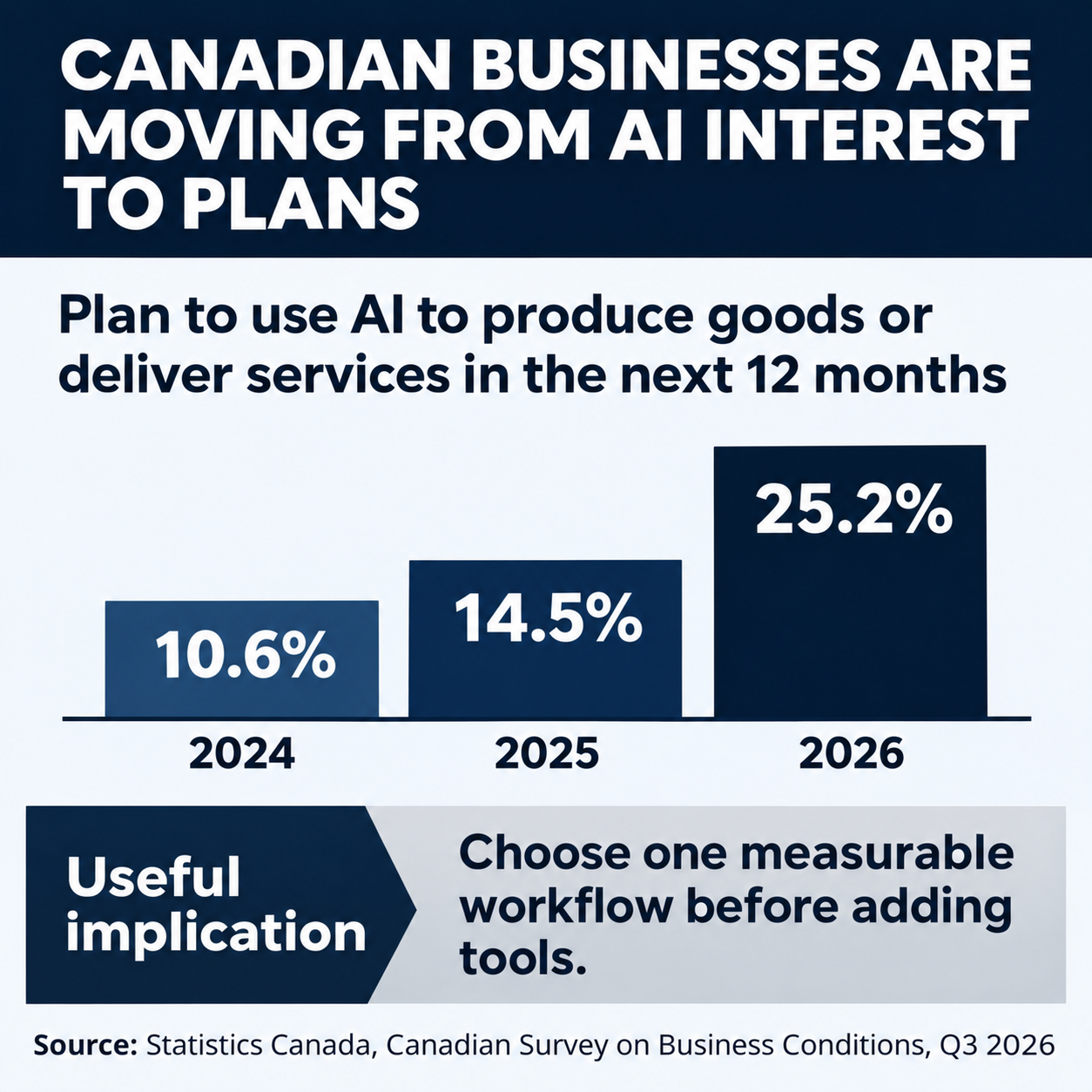
Why a smaller organization should care. More peers are planning to use AI, and public support may lower the cost of a qualified project. Neither fact identifies the right workflow. The useful opportunity is to bring a measured business problem to the technology: known volume, current time, error rate, owner, data boundary and stopping condition.
A useful first test this week. Prepare a one-page workflow brief with ten recent cases, the current full cost, one target outcome, permitted data, required approval and a 90-day stop rule. Use it to compare a small self-funded test with any applicable program. Treat eligibility and approval as questions for the responsible agency, not as assumptions in the budget.
What remains uncertain. Survey intent may not become deployment or value. Program fit, repayment terms, timing and reporting can outweigh support for a small project. If the workflow is rare or already performs well, a clearer checklist or training change may beat an AI investment.
Highest-value moves
- Classify your most valuable public content by crawl, search, training and grounding choice.
- Record each provider control as planned or verified, with an owner and review date.
- Test one measurable workflow and one correction or escalation path before adding scale.
Today's strongest thesis
A preference becomes a business control only when its scope, status and evidence are visible.
Verified sources
- IETF Datatracker: Machine-Readable Training Preference Signal
- Microsoft Bing: Your content, your choice: clearer preferences for training and grounding
- Google Search Central: Supporting a shared AI training control for websites
- IETF AI Preferences Working Group archive: New draft: draft-kelley-aipref-training-preference-signal-00
- Office of the Privacy Commissioner of Canada: Principles for responsible, trustworthy and privacy-protective generative AI technologies
- Canadian Centre for Cyber Security: Generative artificial intelligence - ITSAP.00.041
- Office of the Privacy Commissioner of Canada: Overview of the Joint Investigation of OpenAI OpCo, LLC
- Statistics Canada: Analysis on planned use of artificial intelligence by businesses in Canada, third quarter of 2026
- Federal Economic Development Agency for Southern Ontario: Government of Canada expands support to adopt and commercialize artificial intelligence
Continue your decision path
Move from understanding to action.
Daily Signal: Make the Evidence Smaller and More Useful
Six practical signals on selective telemetry, tool activation, workflow value, risk-focused review and evidence that proves who was allowed to act.
Read nextApply this signal to your architecture.
Identify the workflow, context, and controls to structure first.
Open Architecture Assessment