Operating question
As agents move from private chats into continuous work, Canadian SMEs can create value by giving each job a visible owner, a bounded identity, a human return path and a tested stop rule.
Agent Systems
The Agent Needs a Shared Shift
For
Leaders and workflow owners
You will leave with
4 operating decisions
Reading mode
11 min · 8 verified sources
Reading guide9 sections · Canadian briefing+
Highest-value moves
- 01Put consequential agent work in a shared record that another person can understand and take over.
- 02Choose approval mode before an event trigger acts, and test one explicit stop and restart rule.
- 03Move stable repeated calculations into reviewed deterministic code while keeping judgment visible.
- 04Measure human handbacks and accepted results before increasing agent volume or authority.
Agents are moving into shared workspaces, triggers and business systems. Canadian SMEs can gain by designing ownership, handbacks and stopping rules first.
Today's strongest signal: when an AI tool starts work from a message, opens a task space, calls business systems and keeps running after people move on, the important question is no longer whether it can produce an answer. It is whether the team can see the job, steer it, stop it and take responsibility for the result.
Picture a 45-person Ontario service company. A customer note arrives after hours. An assistant classifies it, checks a contract, drafts a reply and creates a follow-up task. Each step may look useful. Together, they form a small operating process with data access, cost, timing and customer consequences. If that process lives in one employee's private chat, the rest of the team cannot tell what happened or safely take over.
Announcements from the preceding 72 hours point in the same direction. Slack is moving agent work into shared task channels and adding event-triggered actions. Salesforce is connecting evaluations to spending caps and stop controls. IBM is giving agents distinct identities and revocable access. Slack is also pairing fixed workflows with model judgment instead of asking a model to own every step. A new small-business survey reports that wider agent use brings people back into workflows rather than removing them.
The opportunity is practical: a smaller organization can make one repeated job more visible and dependable without building a large AI program. The tradeoff is that shared workspaces and control products add setup, review and administration. A realistic reason not to adopt them is low volume. If a task happens twice a month, a clear checklist and named backup may be cheaper than another platform.
Illustrative scenario: a bilingual equipment distributor lets an assistant prepare service-intake packets from a shared support channel. The agent may read the request and equipment record, but it cannot promise a visit or change the customer file. It posts its sources, missing fields, elapsed cost and proposed next step. A coordinator approves ordinary packets and routes safety complaints to a manager. This scenario is illustrative, not a reported customer case.
1. Give consequential agent work a shared room
What happened. Slack made its Code API generally available, allowing an agent to open a dedicated channel, bring in the right people and files, post progress and archive the space when the task ends. Slack says GitHub Copilot opens one of these channels in 30% of its agent sessions. The operating documentation describes the channels as temporary public or private spaces and notes that availability is still rolling out.
Why a smaller organization should care. The useful idea is not limited to software. A complex quote, supplier exception or policy review may need its own visible task record. A shared room lets another person see the request, evidence, changes and decision without reconstructing a private conversation. It also makes absence coverage easier.
A useful first test this week. Choose one job that normally takes more than one handoff. Create a temporary shared workspace with five required fields: owner, allowed sources, current status, decision needed and final receipt. Let an assistant draft and organize, but keep every external message or record change behind approval. Ask a second employee to take over halfway through using only the workspace.
What remains uncertain. Slack's 30% figure describes one coding integration, not ordinary Canadian office work, and a visible channel does not prove that the underlying action is correct. Shared spaces can also expose information to too many members. If the existing case system already preserves evidence and handoffs well, adding a new channel may split the record rather than improve it.
2. An event trigger needs an approval choice before it fires
What happened. Slack introduced event-triggered tasks that can react to a message, emoji, list update or new channel. A team can choose ask-first approval or automatic action. The same release adds a catalogue and API for reusable skills so approved instructions can be published and updated from code.
Why a smaller organization should care. Event-driven automation removes the delay between noticing and acting. A complaint label could create a case immediately; an approved invoice reaction could prepare a payment packet. But the trigger itself is only a signal. A thumbs-up may mean “seen,” “agreed” or “go ahead,” depending on the team. Turning an ambiguous habit into authority can create quiet mistakes.
A useful first test this week. Run one trigger in observe-only mode for 20 real events. Record what the event meant, what action the system proposed, whether a person accepted it and what information was missing. Define three modes: notify, prepare for approval and execute. Start with notify. Move only a reversible, low-impact action to automatic execution after the acceptance rate and exception list are understood.
What remains uncertain. Vendor controls cannot define your team's meaning or legal authority. Skills can also drift when someone updates a shared instruction. If the event is rare or the meaning changes by customer, a manual triage queue may remain the safer and faster design.
3. Connect the warning to a stopping action
What happened. Salesforce announced agent and API evaluations, budget limits and predefined interventions. Its current generally available controls include a manual kill switch, spending tools and some policies. Evaluation-triggered shutdowns are scheduled for a later release. Salesforce explicitly tells buyers to base decisions on features that are available now.
Why a smaller organization should care. A dashboard that says quality fell or cost rose is not a control unless someone can act in time. For a customer-facing workflow, the response may be to switch to draft-only mode, quarantine new cases or return to the manual process. The same rule can protect a modest budget: when cost per accepted case crosses a limit, stop new runs instead of discovering the overage at month end.
A useful first test this week. Pick one measurable failure, such as a missing source, a wrong customer identifier or a cost ceiling. Write the exact detection rule, the immediate safe state, the person who can restore service and the evidence required to restart. Test the stop and restart in a sandbox. Time how long it takes.
What remains uncertain. Vendor evaluations may not reflect your business outcome, and announced beta features are not present controls. Automatic shutdown can also interrupt legitimate work. If the workflow has low consequence and low volume, a daily exception report with a named owner may be enough.
4. Give each agent its own identity and expiry
What happened. IBM announced generally available agent identity and evaluation capabilities, alongside short-lived credentials and real-time revocation. IBM also described discovery and containment features that remain in preview. The operating principle is clear: an agent has an owner, lifecycle status and limited authority rather than borrowing one broad integration account.
Why a smaller organization should care. Shared credentials make a failure difficult to investigate and contain. If three automations use the same service account, a team may not know which one read a file or changed a record. A distinct identity supports a smaller permission set, clearer logs and a clean offboarding path when the workflow ends.
A useful first test this week. Inventory every automated workflow that can read customer, employee or financial data. For each one, record the owner, credential, permitted systems, permitted actions, expiry and revocation test. Replace one shared or long-lived credential with a task-specific identity or supervised service path. Confirm that revocation blocks new work without erasing the audit record.
What remains uncertain. Enterprise identity products may be too complex for a small stack, and preview discovery will not find personal accounts or unsanctioned browser tools. The useful first move may simply be separate service accounts, short token life and quarterly review. If a tool cannot support bounded credentials, that may be a reason not to connect it to consequential data.
5. Put fixed steps around flexible judgment
What happened. In the same release, Slack described a workflow pattern that combines fixed process steps with model judgment. A form or event starts the workflow, the assistant interprets or drafts, and structured output returns to the fixed process. The model handles ambiguity without becoming the system that owns every transition.
Why a smaller organization should care. A model is useful where language, ambiguity or judgment is involved. It is an expensive and inconsistent place to store a tax rule, margin calculation or customer-status lookup. Once a repeated step is understood, deterministic code—a rule that gives the same result for the same validated input—can lower cost and make review easier.
A useful first test this week. Review 25 recent runs of one assistant. Highlight any validation, lookup, calculation or status change repeated with the same intent. Move one stable step into a typed function, approved report or workflow rule. Keep the model for classifying the case or explaining the result, and compare accepted outputs, correction time, latency and actual usage cost.
What remains uncertain. Fixed workflow steps still need ownership, testing and updates when the business rule changes. A premature rule can freeze a misunderstanding. If the cases vary substantially or the volume is low, a reviewed prompt with manual completion may remain simpler than maintaining another component.
6. Plan for people to re-enter the workflow
What happened. Salesforce summarized a vendor-sponsored survey of 2,025 agentic-AI decision-makers across 20 countries. It reports that 63% encountered agent errors tied to stale, missing or wrong data. As deployments expanded, 81% reported more human re-entry into workflows. Organizations with above-average governance reported proactive problem detection 68% of the time, compared with 55% for those below average, while also taking longer to reach reported return on investment.
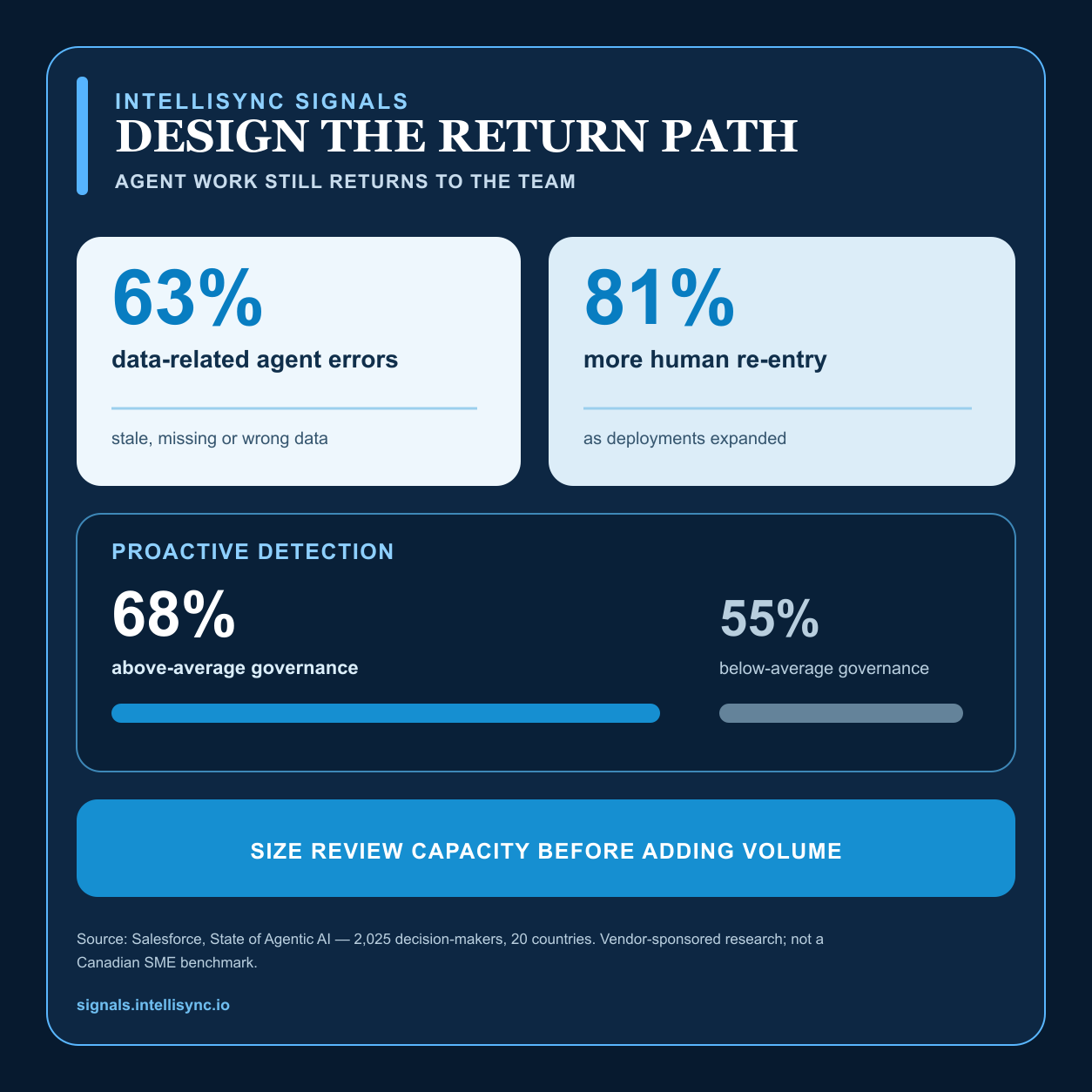
Why a smaller organization should care. The likely operating model is not “hands off.” It is a different division of work. People handle missing context, relationships, exceptions and final authority. If the return path is not designed, those cases arrive as interruptions in private messages and urgent meetings.
A useful first test this week. Add one structured handback to a pilot: reason code, evidence checked, proposed action, deadline and named recipient. Measure how many cases return, why they return and how long they wait. Use that information to size review capacity before increasing volume.
What remains uncertain. This is self-reported, global, vendor-sponsored research; it does not establish a Canadian SME benchmark or prove causation. More human re-entry can mean healthy oversight or poor automation. If handbacks consume more time than the original task, the right answer may be to narrow or retire the automation.
7. Bring a measured workflow to Canadian support
What happened. BDC's national LIFT initiative pairs eligible Canadian SMEs with AI advisors and flexible financing while prioritizing Canadian-developed tools. In the Prairies, Amii announced expanded federal support and direct adoption capacity for 25 new SMEs. Program fit, financing and participation decisions remain with the responsible organizations.
Why a smaller organization should care. Support is most useful when it accelerates a defined change, not when it chooses the problem. A measured workflow gives an applicant, advisor or lender something concrete to assess: current volume, delay, error, owner, data boundary, permitted action and expected result.
A useful first test this week. Prepare a one-page evidence packet for one workflow. Include ten baseline cases, the current full cost, the proposed boundary, the employee responsible, the 90-day measure and the stop condition. Ask a regional program officer or qualified advisor about fit only after the packet is honest about readiness and gaps.
What remains uncertain. A listed program is not approval, and terms differ by region, applicant and cost. LIFT or the Prairie program may not apply to your location, readiness or project. If the expected improvement is modest, the application and reporting burden may cost more than a self-funded test.
Highest-value moves
- Move one consequential AI-assisted job into a shared record with an owner, evidence and decision status.
- Define one stop rule and prove that a second person can pause, inspect and restart the workflow safely.
- Measure handbacks and accepted results before adding more triggers, tools or volume.
Today's strongest thesis
An agent becomes useful business capacity only when the team can see the job, take it over and stop it.
Verified sources
- Slack: Introducing the Slack Code API: Your agents, your team, one code channel
- Slack Help Center: Build with AI as a team using Slack Code
- Slack: Slackbot gets more proactive, in more places
- Salesforce: Salesforce Expands Agent Fabric to Automatically Stop Runaway Costs and AI Agent Failures Before They Impact Customers
- IBM: IBM Introduces Identity and Control for AI Agents, Securing Frontier Intelligence for the Enterprise
- Salesforce: 4 Takeaways From the State of Agentic AI Report for Small Business
- Business Development Bank of Canada: BDC Launches LIFT: Getting Canadian SMEs off the AI sidelines
- Alberta Machine Intelligence Institute: Amii and PrairiesCan Expand Successful AI Adoption Program Across the Prairies
Continue your decision path
Move from understanding to action.
Daily Signal: Give every agent an independent record
Seven practical signals for Canadian operators: stronger models, cheaper routing, persistent agents, independent evidence, containment, cost ownership, and correlated risk.
Read nextApply this signal to your architecture.
Identify the workflow, context, and controls to structure first.
Open Architecture Assessment